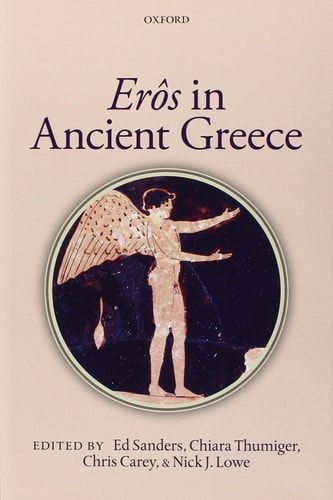
Erôs in Ancient Greece
0
0
As an Amazon Associate and affiliate partner, Menrva Books earns from qualifying purchases. Learn more
Author Description
This edited volume brings together eighteen articles which examine the role of eros as an emotion in ancient Greek culture. Arising out of a conference held at University College London in 2009, the volume ranges from Archaic epic and lyric poetry, through tragedy and comedy, to philosophical and technical treatises and more, and includes contributions from a variety of international scholars well published in the field of ancient Greek emotions.Taking into account all important thinking about the nature of eros from the eighth century BCE to the third century CE, and covering a very broad range of sources and theoretical approaches, both in the chronological and the generic sense, it considers the phenomenology, psychology, and physiology of eros; its associated language, metaphors, and imagery; the overlap of eros with other emotions (jealousy, madness, philia, pothos); its role in political society; and the relationship between the human emotion and Eros the god. These topics build on recent advances in the understanding of ancient Greek homo- and heterosexual customs and practices, visual and textual erotica, and philosophical approaches to eros as manageable appetite or passion. However, the principal aim of the volume is to apply to the study of eros the theoretical insights offered by the rapidly expanding field of emotion studies, both in ancient cultures and elsewhere in the humanities and social sciences, thus maintaining throughout the focus on eros as emotion.
Menrva's Summary
THE THESIS
This volume investigates the multifaceted role of eros as a complex emotion within the cultural, social, and philosophical frameworks of ancient Greece. Edited by Chiara Thumiger, Christopher Carey, Ed Sanders, and Nick Lowe, the collection synthesizes research from eighteen international scholars to analyze how the Greeks conceptualized, experienced, and represented desire. By applying contemporary emotion studies to historical texts, the authors argue that eros functioned as a dynamic intersection of psychology, physiology, and social practice from the eighth century BCE to the third century CE.
THE SCOPE MAP
What You Will Find
- Analysis of eros across diverse literary genres including epic, lyric poetry, tragedy, comedy, and philosophical treatises.
- Examination of the phenomenology, psychology, and physiology of desire in the ancient world.
- Exploration of the conceptual overlap between eros and related states such as jealousy, madness, philia, and pothos.
- Investigation into the intersection of human emotional experience and the mythological personification of Eros.
THE AUTHORITY PERSPECTIVE
Experts recognize this collection as a significant contribution to the study of ancient Greek emotions, noting its rigorous application of modern theoretical frameworks to classical sources. Scholars frequently highlight the volume's breadth, which successfully bridges the gap between historical textual analysis and contemporary psychological inquiry.
Page Count:
368
Publication Date:
2013-04-05
Publisher:
Oxford University Press
ISBN-10:
0199605505
ISBN-13:
9780199605507
History
Philosophy
Psychology
Ancient Greece
In literature
Criticism history
Community Tags
Similar Books