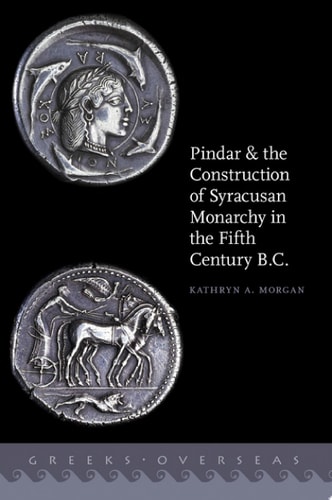
Pindar and the Construction of Syracusan Monarchy in the Fifth Century B.C.
0
0
As an Amazon Associate and affiliate partner, Menrva Books earns from qualifying purchases. Learn more
Author Description
This groundbreaking book attempts a fully contextualized reading of the poetry written by Pindar for Hieron of Syracuse in the 470s BC. It argues that the victory odes and other occasional songs composed by Pindar for the Sicilian tyrant were part of an extensive cultural program that included athletic competition, coinage, architecture, sanctuary dedication, city foundation, and much more. In the tumultuous years following the Persian invasion of Greece in 480, elite Greek leaders and their cities struggled to capitalize on the Greek victory and to define themselves as free peoples who triumphed over the threat of Persian monarchy. Pindar's victory odes are an important contribution to Hieron's goal of panhellenic pre-eminence, redescribing contemporary tyranny as an instantiation of golden-age kingship and consonant with best Greek tradition. In a delicate process of cultural legitimation, the poet's praise deploys athletic victories as a signs of more general preeminence. Three initial chapters set the stage by presenting the history and culture of Syracuse under the Deinomenid tyrants, exploring issues of performance and patronage, and juxtaposing Hieron to rival Greek leaders on the mainland. Subsequent chapters examine in turn all Pindar's preserved poetry for Hieron and members of his court, and contextualizes this poetry by comparing it to the songs written for Hieron by Pindar's poetic contemporary, Bacchylides. These odes develop a specifically “tyrannical” mythology in which a hero from the past enjoys unusual closeness with the gods, only to bring ruin on him or herself by failing to manage this closeness appropriately. Such negative exemplars counterbalance Hieron's good fortune and present the dangers against which he must (and does) protect himself by regal virtue. The readings that emerge are marked by exceptional integration of literary interpretation with the political/historical context.
Menrva's Summary
THE THESIS
This book investigates how Pindar’s victory odes functioned as a strategic cultural instrument to legitimize and construct the image of Syracusan monarchy under Hieron I during the fifth century B.C. Kathryn A. Morgan, a scholar of Greek literature and history, utilizes a multidisciplinary approach to analyze the intersection of poetic performance, political patronage, and the broader cultural program of the Deinomenid tyrants. By situating these poems within the post-Persian War geopolitical landscape, the author argues that Pindar’s work served to reframe contemporary tyranny as a form of idealized, traditional kingship.
THE SCOPE MAP
What You Will Find
- A detailed analysis of Pindar’s victory odes and occasional songs composed for Hieron of Syracuse.
- A comparative study of Pindar’s poetry alongside the works of his contemporary, Bacchylides.
- An examination of the Deinomenid cultural program, including coinage, architecture, and sanctuary dedications.
- A framework for interpreting the use of mythological exemplars in political praise poetry.
Scope Limits
- The study focuses primarily on the specific political context of Syracuse in the 470s B.C. and does not provide a comprehensive biography of Pindar.
- The analysis is limited to the preserved poetry associated with Hieron and his court rather than the entirety of the Pindaric corpus.
THE AUTHORITY PERSPECTIVE
Scholars and classicists frequently cite this work for its rigorous integration of literary analysis with historical and political context. It is widely regarded as a significant contribution to the study of ancient patronage and the role of poetry in the construction of political authority.
Page Count:
480
Publication Date:
2015-01-01
Publisher:
Oxford University Press
ISBN-10:
0190266619
ISBN-13:
9780190266615
Poetry
History
Ancient Greece
Italy history
Criticism history
Pindar
English & College Success
Literary Criticism
English
Political History
Ancient History
Community Tags
Other Editions(2)
Similar Books












Reader Comments
Share Your Thoughts
No comments yet. Be the first to share your thoughts!