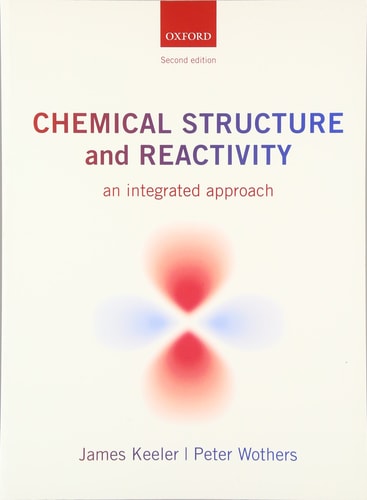
Chemical Structure and Reactivity
0
0
As an Amazon Associate and affiliate partner, Menrva Books earns from qualifying purchases. Learn more
Author Description
Why do certain substances react together in the way that they do? What determines the shape of molecules? And how can we predict whether a particular reaction will happen at all?Such questions lie at the heart of chemistry - the science of understanding the composition of substances, their reactions, and properties. Though introductory chemistry is often broken into three sections-inorganic, organic, and physical-the only way for students to fully understand the subject is to see it as a single, unified whole.Chemical Structure and Reactivity rises to the challenge of depicting the reality of chemistry. Offering a fresh approach to the subject by depicting it as a seamless discipline, the text shows how organic, inorganic, and physical concepts can be blended together in order to achieve the common goal of understanding chemical systems.With a lively and engaging writing style enhanced by vivid illustrations, only Chemical Structure and Reactivity makes teaching chemistry with an integrated approach possible.Special Features--The only introductory text to take a truly integrated approach in explaining the fundamentals of chemistry.--Fosters an orbital-based understanding of reactions, with clear curly-arrow mechanistic detail throughout.--A two-part structure allows flexibility of use: Part I lays down the core of the subject, while Part II describes a series of relatively standalone topics, which can be selected to fit a particular course.--Numerous concepts are illustrated with fully cross-referenced custom-developed online modules, enabling students to develop an understanding through active learning.--Self-test exercises embedded in the text (with solutions at the end of each chapter) and extensive question sets encourage hands-on learning, to help students master the subject and gain confidence.--The Online Resource Centre features a range of additional resources for both students and registered adopters of the book.New to this Edition--A new chapter on symmetry has been added to Part I.--Discussions of organometallic chemistry, spectroscopy, and molecular geometry have been expanded.--Cross references from Part I to Part II have been increased to make the links between core concepts and more advanced topics clearer.--More self-test questions and exercises have been provided.
Menrva's Summary
THE THESIS
This text investigates the fundamental question of how chemical structure dictates reactivity by unifying the traditionally siloed disciplines of organic, inorganic, and physical chemistry. Authors James Keeler and Peter Wothers, both established academics in the field, argue that a fragmented approach to chemistry hinders student comprehension. By utilizing an orbital-based framework, they present a cohesive model that allows students to predict molecular behavior and reaction outcomes through a singular, integrated lens.
THE SCOPE MAP
What You Will Find
- An integrated pedagogical framework that blends organic, inorganic, and physical chemistry concepts.
- Detailed explanations of reaction mechanisms using orbital theory and curly-arrow notation.
- A two-part structural design separating core foundational principles from specialized, standalone topics.
- Embedded self-test exercises and extensive question sets designed for active learning and mastery.
THE AUTHORITY PERSPECTIVE
Educators and students frequently cite this text as a superior resource for moving beyond rote memorization toward a deeper, mechanistic understanding of chemical systems. Experts highlight the book's integrated approach as a significant departure from standard introductory curricula, noting its effectiveness in bridging the gap between theoretical models and practical application.
Page Count:
877
Publication Date:
2013-01-01
Publisher:
Oxford University Press
ISBN-10:
0199604134
ISBN-13:
9780199604135
Science
textbook
Inorganic Chemistry
Chemistry
Organic chemistry
Physical Chemistry
Community Tags
Similar Books




Reader Comments
Share Your Thoughts
No comments yet. Be the first to share your thoughts!