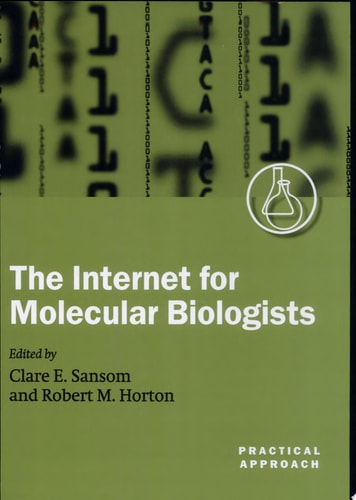
The Internet for Molecular Biologists: A Practical Approach
0
0
As an Amazon Associate and affiliate partner, Menrva Books earns from qualifying purchases. Learn more
Author Description
The last few decades of the twentieth century will be remembered for two technological revolutions that have already had a profound effect on millions of people's lives. Thanks to communication technologies, and particularly the Internet, we now take immediate access to enormous quantities of information for granted. And thanks to "the new biology," building on the genome projects, some scientists are predicting that cures for the majority of known diseases could be readily available within two generations. These two revolutions are inextricably linked: molecular biology depends on the ready availability of data, and that needs computers and the Internet. There are some surprising parallels between developments in the two technologies. For example, the publicly available gene sequence databases, EMBL and GenBank, are doubling in size approximately every eighteen months. According to Moore's Law, which has held since the invention of the silicon chip, eighteen months is also the time frame in which computer power is expected to double.This book aims to help the practitioners of the second revolution - molecular biologists who are more at home at a laboratory bench than in front of a computer keyboard - to use the technology of the first, the Internet, more effectively. The Internet For Molecular Biologists - A Practical Approach provides a broad introduction to using Internet based computing resources to support research in molecular biology. After surveying the core databases and other online resources, the focus shifts to tools and techniques for exploiting and authoring Internet-distributed information. Later chapters provide detailed examples of how technologies such as molecular visualisation, VRML and XSLT can be applied to biological problems.
Menrva's Summary
THE THESIS
How can molecular biologists effectively leverage the Internet to manage the exponential growth of genomic data and enhance their research capabilities? The authors, Clare E. Sansom and Robert M. Horton, address the gap between traditional laboratory bench work and the computational demands of modern genomics. They present a framework for integrating Internet-based tools into biological research, arguing that proficiency in digital data management is as critical to the field as wet-lab expertise.
THE SCOPE MAP
What You Will Find
- Comprehensive overview of core biological databases like EMBL and GenBank
- Methodologies for effective information retrieval and data authoring
- Technical applications of molecular visualization software
- Practical implementation guides for VRML and XSLT in biological contexts
THE AUTHORITY PERSPECTIVE
Experts recognize this text as a foundational resource for bridging the gap between computational science and molecular biology. Readers frequently note the technical utility of the provided examples for researchers transitioning into data-heavy workflows.
Page Count:
280
Publication Date:
2004-04-08
Publisher:
Oxford University Press
ISBN-10:
0199638888
ISBN-13:
9780199638888
Science
Biology
Internet
Reference
Technology
Science
Community Tags
Similar Books