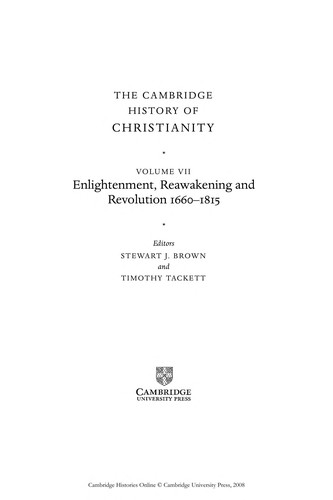
Enlightenment, Reawakening and Revolution 1660-1815
0
0
As an Amazon Associate and affiliate partner, Menrva Books earns from qualifying purchases. Learn more
Author Description
During the tumultuous period of world history from 1660 to 1815, three complex movements combined to bring a fundamental cultural reorientation to Europe and North America, and ultimately to the wider world. The Enlightenment transformed views of nature and of the human capacity to master nature. The religious reawakenings brought a revival of heart-felt, experiential Christianity. Finally revolution, the political and social upheavals of the late eighteenth and early nineteenth centuries, challenged established ideas of divine-right monarchies and divinely ordained social hierarchies, and promoted more democratic government, notions of human rights, and religious toleration. A new religious climate emerged, in which people were more likely to look to their own feelings and experiences for the basis of their faith. During this same period, Christianity spread widely around the world as a result of colonialism and missions, and responded in diverse ways to its encounters with other cultures and religious traditions.
Menrva's Summary
THE THESIS
This book investigates the confluence of the Enlightenment, religious reawakenings, and revolutions in shaping the modern world between 1660 and 1815. It examines how these three powerful movements fundamentally reoriented European and North American culture, ultimately impacting global perspectives on nature, human capacity, governance, and faith. The author, Stewart J. Brown, draws upon historical analysis to demonstrate how new ideas about reason, experiential faith, and democratic ideals challenged existing social and political structures. The book explores the emergence of a new religious climate focused on personal feeling and the global spread of Christianity amidst colonialism and missions.
THE SCOPE MAP
- The transformative impact of the Enlightenment on views of nature and human mastery.
- The phenomenon of religious reawakenings and the revival of experiential Christianity.
- The political and social upheavals of revolutions challenging monarchies and hierarchies.
- The promotion of democratic government, human rights, and religious toleration.
- The development of a new religious climate emphasizing personal faith and experience.
- The global spread of Christianity through colonialism and missions.
- Christianity's diverse responses to encounters with other cultures and religious traditions.
THE AUTHORITY PERSPECTIVE
The book is presented as a comprehensive analysis of a pivotal era in Western and global history, focusing on the interconnectedness of intellectual, religious, and political transformations. The scope suggests a detailed examination of the period's key movements and their lasting impact on societal structures and individual belief systems. The author's approach appears to synthesize major historical trends to offer a cohesive narrative of cultural reorientation. The material indicates a scholarly work intended for readers interested in the deep historical roots of modern thought and governance.
Page Count:
694
Publication Date:
2007-01-01
ISBN-10:
052181605X
ISBN-13:
9780521816052
Non-Fiction
History
Religious History
Intellectual History
European History
American History
Community Tags
Similar Books