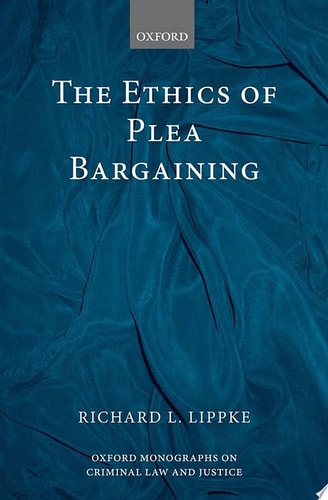
The Ethics of Plea Bargaining
0
0
As an Amazon Associate and affiliate partner, Menrva Books earns from qualifying purchases. Learn more
Author Description
The practice of plea bargaining plays a hugely significant role in the adjudication of criminal charges and has provoked intense debate about its legitimacy. This book offers the first full-length philosophical analysis of the ethics of plea bargaining. It develops a sustained argument for restrained forms of the practice and against the free-wheeling versions that predominate in the United States.In countries that have endorsed plea bargains, such as the United States, upwards of ninety percent of criminal defendants plead guilty rather than go to trial. Yet trials, which grant a presumption of innocence to defendants and place a substantial burden of proof on the state to establish guilt, are widely regarded as the most appropriate mechanisms for fairly and accurately assigning criminal sanctions. How is it that many countries have abandoned the formal rules and rigorous standards of public trials in favor of informal and veiled negotiations between state officials and criminal defendants concerning the punishment to which the latter will be subjected? More importantly, how persuasive are the myriad justifications that have been provided for plea bargaining? These are the questions addressed in this book.Examining the legal processes by which individuals are moved through the criminal justice system, the fairness of those processes, and the ways in which they reproduce social inequality, this book offers an ethical argument for restrained forms of plea bargaining. It also provides a comparison between the different plea bargaining regimes that exist within the US, where it is well-established, England and Wales, where the practice is coming under considerable critique, and the European Union, where debate continues on whether it coheres with inquisitorial legal regimes. It suggests that rewards for admitting guilt are distinguished from penalties for exercising the right to trial, and argues for modest, fixed sentence reductions for defendants who admit their guilt. These suggestions for reform include discouraging the current practice of deliberate over-charging by prosecutors and charge bargaining, and require judges to scrutinize more closely the evidence against those accused of crimes before any guilty pleas are entered by them. Arguing that the negotiation of charges and sentences should remain the exception, not the rule, it nevertheless puts forward a normative defense for the reform and retention of the plea bargaining system.
Menrva's Summary
THE THESIS
This book investigates the ethical legitimacy of plea bargaining within modern criminal justice systems, questioning how informal negotiations have largely replaced the formal trial process. Richard L. Lippke, a scholar in legal philosophy, utilizes a normative framework to evaluate the fairness and social implications of current plea practices. He argues that while the current system in the United States is overly permissive, a more restrained and regulated model of plea bargaining could potentially align with principles of justice and due process.
THE SCOPE MAP
What You Will Find
- A comparative analysis of plea bargaining regimes in the United States, England, Wales, and the European Union.
- An ethical framework distinguishing between rewards for guilty pleas and penalties for exercising trial rights.
- A critique of how current plea practices reproduce social inequality and undermine the presumption of innocence.
- Proposed reforms advocating for modest, fixed sentence reductions to maintain procedural fairness.
THE AUTHORITY PERSPECTIVE
Legal scholars and practitioners identify this work as a significant contribution to the philosophy of criminal law. Readers frequently note the academic density of the prose, which serves as a foundational text for those analyzing the intersection of ethics and judicial administration.
Page Count:
300
Publication Date:
2011-12-17
Publisher:
Oxford University Press
ISBN-10:
0199641463
ISBN-13:
9780199641468
Philosophy
Ethics
Law
Community Tags
Similar Books











Reader Comments
Share Your Thoughts
No comments yet. Be the first to share your thoughts!