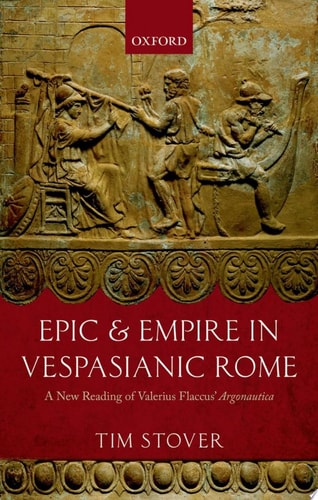
Epic and Empire in Vespasianic Rome: A New Reading of Valerius Flaccus' Argonautica
0
0
As an Amazon Associate and affiliate partner, Menrva Books earns from qualifying purchases. Learn more
Author Description
Epic and Empire in Vespasianic Rome offers a new interpretation of Valerius Flaccus' Argonautica, a Latin epic poem written during the reign of the emperor Vespasian (70-79 AD). Recounting the famous voyage of Jason and the Argonauts as they set off to retrieve the Golden Fleece, the poem depicts a narrative of high epic adventure. In this volume, Stover shows how Flaccus' epic reflects the restorative ideals of Vespasianic Rome, which attempted to restore order following the destructive civil war of 68-69 AD. This proposition sets it apart from the largely 'pessimistic' readings of other scholars.An important element of Flaccus' poetics of recovery is an engagement with Lucan's iconoclastic Bellum Civile. This poem's deconstructive tendencies offered Flaccus a poetic point of departure for his attempt to renew the epic genre in the context of political renewal triggered by Vespasian's accession to power. Stover's approach is thus both formalist and historicist as he seeks not only to elucidate Flaccus' dynamic appropriation of Lucan, but also to associate the Argonautica's formal gestures within a specific socio-political context.
Menrva's Summary
THE THESIS
This book investigates how Valerius Flaccus' Argonautica functions as a reflection of the restorative political climate during the reign of Emperor Vespasian. Tim Stover, a scholar of Latin literature, utilizes a dual methodology that combines formalist analysis of the text with historicist inquiry into the socio-political environment of 70-79 AD. He argues against prevailing pessimistic interpretations, proposing instead that the poem serves as a deliberate attempt to renew the epic genre in alignment with the stabilization of the Roman state following civil war.
THE SCOPE MAP
What You Will Find
- Analysis of the Argonautica within the specific historical context of the Vespasianic era.
- Examination of the intertextual relationship between Valerius Flaccus and Lucan's Bellum Civile.
- A formalist study of epic narrative structures and their adaptation for political messaging.
- Discussion of the 'poetics of recovery' as a mechanism for cultural and imperial restoration.
THE AUTHORITY PERSPECTIVE
Scholars recognize this work as a significant contribution to the study of Flavian literature, particularly for its challenge to the established critical consensus regarding the poem's tone. Readers frequently note the academic density of the prose, which is intended for specialists in Latin epic and Roman history.
Page Count:
256
Publication Date:
2012-09-07
Publisher:
Oxford University Press
ISBN-10:
019964408X
ISBN-13:
9780199644087
History
Poetry
Criticism history
In literature
Epic
Literary Criticism
Rome
Community Tags
Similar Books