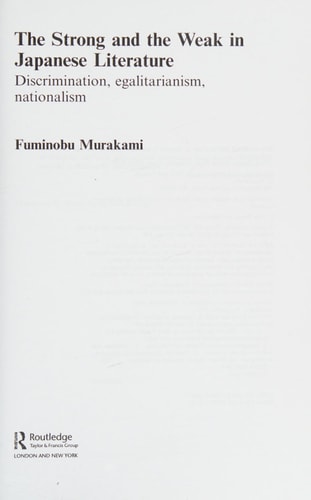
The Strong and the Weak in Japanese Literature: Discrimination, Egalitarianism, Nationalism
0
0
As an Amazon Associate and affiliate partner, Menrva Books earns from qualifying purchases. Learn more
Author Description
This book uses texts from classical to modern Japanese literature to examine concepts of 'respect for the strong', as a notion of an evolutionary society, and 'sympathy for the weak', as a notion of a non-violent and changeless egalitarian society. The term strong refers not just to those with strength and power. It also includes other ideal attributes such as beauty, youth and goodness. Similarly, the term weak implies not only the weak and infirm, but also the disadvantaged, the indecent, the unsophisticated and those generally shunned by society. The former are associated not only with the power of life, competition, evolution, progress, development, ability, effectiveness, efficiency, individuality, the future, hope and romance, but also with violence, fighting, bullying, discrimination and sacrifice. The latter, in contrast, invoke notions of peace, egalitarianism, anti-discrimination and welfare, as well as stagnation, retreat, retrogression, degeneration and the decline of vital powers.By using these two concepts Murakami skillfully weaves a narrative that is part literary criticism, part social commentary. As such the book will be of huge interest to not only scholars and students of Japanese literature, but also those of Japanese society and culture.
Menrva's Summary
THE THESIS
This book investigates the dichotomy between the 'strong' and the 'weak' as a foundational tension within Japanese literary history and social thought. Fuminobu Murakami, a scholar of Japanese literature, utilizes a wide range of texts spanning from the classical period to the modern era to analyze how these concepts shape national identity. He argues that the tension between evolutionary progress and egalitarian sympathy reveals deep-seated contradictions in Japanese cultural values regarding power, morality, and social structure.
THE SCOPE MAP
What You Will Find
- Analysis of classical and modern Japanese literary texts.
- A framework contrasting evolutionary 'strength' with egalitarian 'weakness'.
- Examination of social themes including discrimination, nationalism, and welfare.
- Exploration of how literary tropes reflect broader societal attitudes toward power and vulnerability.
THE AUTHORITY PERSPECTIVE
Scholars and students of Japanese culture frequently cite this work as a significant contribution to the intersection of literary analysis and social commentary. Experts highlight the text for its ability to synthesize complex philosophical concepts into a coherent critique of Japanese societal evolution.
Page Count:
195
Publication Date:
2010-01-01
Publisher:
Routledge
ISBN-10:
0203851595
ISBN-13:
9780203851593
History
Criticism history
In literature
Literary Criticism
Japanese
Sociology
Community Tags
Similar Books