The FBI's RACON
0
0
As an Amazon Associate and affiliate partner, Menrva Books earns from qualifying purchases. Learn more
Author Description
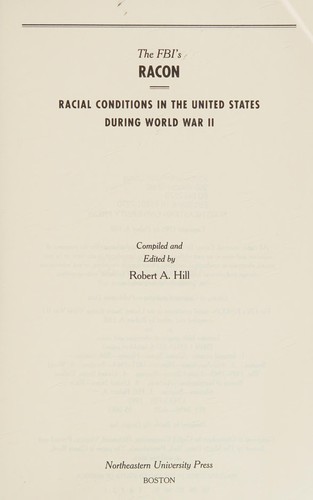
During World War II, an unprecedented wave of militant black protest and activism swept through the United States, setting the stage for the civil rights movements of the 1950s and 1960s. FBI director J. Edgar Hoover perceived this racial turmoil as a threat not only to wartime mobilization efforts but also to the preservation of a stable, segregated society, and ordered an extensive, nationwide investigation and surveillance of African Americans "to determine why particular Negroes or groups of Negroes or Negro organizations have evidenced sentiments for other 'dark races' (mainly Japanese) or by what forces they were influenced to adopt in certain instances un-American ideologies." The unstated objective of the inquiry, known by the secret code name RACON, was to neutralize the black challenge to the institutional grip of Jim Crow. This landmark volume publishes for the first time the FBI's Survey of Racial Conditions in the United States, an exhaustive report that grew out of the larger internal security investigation. Compiled from reports submitted by fifty-six field units in all areas of the country, the document chronicles in rich detail the experience of African Americans during World War II. A comprehensive introduction by Robert A. Hill situates the FBI report within a political, cultural, and literary context to provide a fuller understanding of this sparsely documented period in African-American history and its relationship to civil rights movements in the postwar era. Hill also explores the ways in which the investigation and surveillance of blacks during World War II illuminate the FBI's wartime evolution from an investigative body to a political counterintelligence agency.
Menrva's Summary
THE THESIS
The FBI's RACON project investigated African American activism during World War II to neutralize challenges to Jim Crow. J. Edgar Hoover, perceiving black protest as a threat to wartime mobilization and a stable, segregated society, initiated a nationwide surveillance of African Americans. The unstated objective was to dismantle the black challenge to institutionalized segregation. This volume publishes the FBI's Survey of Racial Conditions in the United States, an exhaustive report compiled from fifty-six field units, detailing African American experiences during the war.
THE SCOPE MAP
- The FBI's Survey of Racial Conditions in the United States, a primary source document.
- Analysis of African American activism and protest during World War II.
- Details of J. Edgar Hoover's directive and the FBI's surveillance methods.
- Exploration of the FBI's evolution into a political counterintelligence agency.
- Contextualization of the report within the broader civil rights movements.
- Examination of the relationship between wartime activism and postwar civil rights struggles.
THE AUTHORITY PERSPECTIVE
This landmark volume is recognized for its critical publication of the FBI's Survey of Racial Conditions, offering unprecedented insight into the federal government's surveillance of African Americans during World War II. The introduction by Robert A. Hill situates the report within its historical and political context, illuminating the period's challenges to segregation and the precursors to the civil rights era. Scholars and students of American history, African American studies, and government surveillance will find this work an essential resource for understanding the complex interplay between activism, federal power, and the fight for civil rights.
Page Count:
793
Publication Date:
1995-01-01
ISBN-10:
1555532276
ISBN-13:
9781555532277
History
Non-Fiction
Government Surveillance
Civil Rights