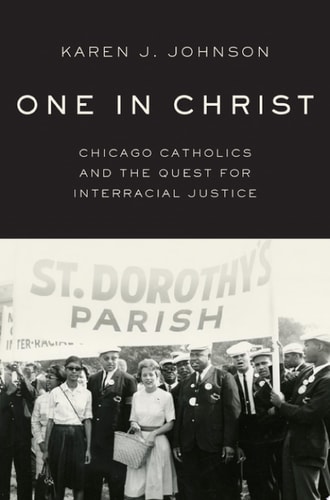
One in Christ: Chicago Catholics and the Quest for Interracial Justice
0
0
As an Amazon Associate and affiliate partner, Menrva Books earns from qualifying purchases. Learn more
Author Description
Today, the images of Catholic priests and nuns marching in 1960s civil rights protests are iconic. Their cassocks and habits clothed the movement in sacred garments. But by the time of those protests Catholic Civil Rights activism already had a long history, one in which the religious leadership of the Church played, at best, a supporting role. Instead, it was laypeople, first African Americans and then, as they found white partners, black and white Catholics working together, who shaped the movement- regular people who, in self-consciously Catholic ways, devoted their time, energy, and prayers to what they called "interracial justice," a vision of economic, social, religious, and civil equality. Karen J. Johnson tells the story of Catholic interracial activism from the bottom up through the lives of a group of women and men in Chicago who struggled with one another, their Church, and their city to try to live their Catholic faith in a new, and what they thought was more complete and true, way. Black activists found a handful of white laypeople, some of whom later became priests, who believed in their vision of a universal church in the segregated city. Together, they began to fight for interracial justice, all while knitted together in sometimes-contentious friendship as members of the Mystical Body of Christ. In the end, not only had Catholic activists lived out their faith as active participants in the long civil rights movement and learned how to cooperate, and indeed love, across racial lines, but they had changed the practice of Catholicism. They broke down the hierarchy that placed priests above the laity and crossed the parish boundaries that defined urban Catholicism. Chicago was a vital laboratory in what became a national story. One in Christ traces the development of Catholic interracial activism, revealing the ways religion and race combined both to enforce racial hierarchies and to tear them down, and demonstrating that we cannot understand race and civil rights in America without understanding the role of religion.
Menrva's Summary
THE THESIS
How did lay Catholic activists in Chicago navigate the intersection of religious faith and racial justice during the mid-twentieth century? Karen J. Johnson, a historian of American religion, examines the grassroots efforts of black and white Catholics who challenged segregated structures within their city and their own Church. She argues that these individuals, operating outside the traditional clerical hierarchy, redefined the practice of Catholicism by centering their faith on the concept of the Mystical Body of Christ to pursue social and civil equality.
THE SCOPE MAP
What You Will Find
- Historical analysis of Catholic interracial activism in Chicago from the early to mid-twentieth century.
- Examination of the shift from clerical-led initiatives to lay-driven social movements.
- Primary source research involving personal accounts of activists who crossed parish and racial boundaries.
Scope Limits
- The study focuses primarily on the Chicago metropolitan area rather than providing a comprehensive national history of the movement.
- The narrative centers on laypeople, providing less detail on the internal administrative policies of the Vatican or the broader institutional hierarchy.
THE AUTHORITY PERSPECTIVE
Scholars and historians recognize this work as a significant contribution to the study of American religious history and the civil rights movement. Readers frequently note the depth of the archival research and the clarity with which Johnson connects local Chicago activism to broader national trends in racial justice.
Page Count:
320
Publication Date:
2018-01-01
Publisher:
Oxford University Press
ISBN-10:
019061899X
ISBN-13:
9780190618995
History
Religion
United States
Catholicism
American History
Social justice
Sociology
Civil Rights
Community Tags
Similar Books







Reader Comments
Share Your Thoughts
No comments yet. Be the first to share your thoughts!