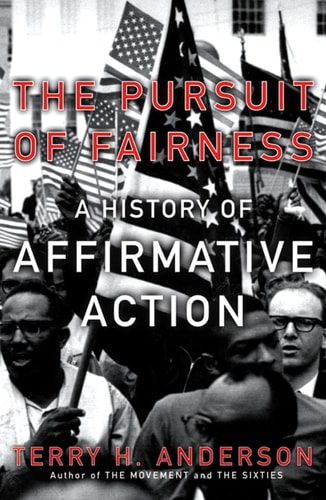
The Pursuit of Fairness: A History of Affirmative Action
0
0
As an Amazon Associate and affiliate partner, Menrva Books earns from qualifying purchases. Learn more
Author Description
Affirmative action strikes at the heart of deeply held beliefs about employment and education, about the concepts of justice and fairness, and about the troubled history of race relations in America. Published on the 50th anniversary of Brown v. Board of Education, this is the only book available that gives readers a balanced, non-polemical, and lucid account of this highly contentious issue. Beginning with the roots of affirmative action, Anderson describes African-American demands for employment in the defense industry--spearheaded by A. Philip Randolph's threatened March on Washington in July 1941--and the desegregation of the armed forces after World War II. He investigates President Kennedy's historic 1961 executive order that introduced the term "affirmative action" during the early years of the civil rights movement and he examines President Johnson's attempts to gain equal opportunities for African Americans. He describes President Nixon's expansion of affirmative action with the Philadelphia Plan--which the Supreme Court upheld--along with President Carter's introduction of "set asides" for minority businesses and the Bakke ruling which allowed the use of race as one factor in college admissions. By the early 1980s many citizens were becoming alarmed by affirmative action, and that feeling was exemplified by the Reagan administration's backlash, which resulted in the demise and revision of affirmative action during the Clinton years. He concludes with a look at the University of Michigan cases of 2003, the current status of the policy, and its impact. Throughout, the author weighs each side of every issue--often finding merit in both arguments--resulting in an eminently fair account of one of America's most heated debates. A colorful history that brings to life the politicians, legal minds, and ordinary people who have fought for or against affirmative action, The Pursuit of Fairness helps clear the air and calm the emotions, as it illuminates a difficult a
Menrva's Summary
THE THESIS
This book investigates the historical development, implementation, and societal impact of affirmative action policies in the United States from the 1940s to the early 2000s. Terry H. Anderson, a historian, utilizes primary source documents, executive orders, and Supreme Court rulings to construct a balanced analysis of how these policies evolved through successive presidential administrations. The work argues that affirmative action remains a central, albeit contentious, mechanism for addressing historical racial inequality in employment and education.
THE SCOPE MAP
What You Will Find
- Historical analysis of the civil rights movement from 1941 to 2003.
- Detailed examination of executive actions from Presidents Kennedy, Johnson, Nixon, and Carter.
- Legal analysis of landmark cases including the Bakke ruling and the University of Michigan cases.
- Discussion of the political backlash during the Reagan and Clinton administrations.
Scope Limits
- The text does not provide an exhaustive legal treatise on every minor local policy variation.
- The analysis concludes in 2003 and does not cover subsequent judicial developments or legislative changes occurring after that year.
THE AUTHORITY PERSPECTIVE
Experts and reviewers frequently cite this work as a foundational, balanced resource for understanding the complex evolution of affirmative action in America. Readers often note that the prose remains accessible and objective, making it a standard text for those seeking to understand the historical context of current debates on equality.
Page Count:
344
Publication Date:
2004-01-01
Publisher:
Oxford University Press
ISBN-10:
019028904X
ISBN-13:
9780190289041
History
Law
Sociology
American History
Ethnic Studies
United States
Civil Rights
Community Tags
Other Editions(2)

Similar Books







Reader Comments
Share Your Thoughts
No comments yet. Be the first to share your thoughts!