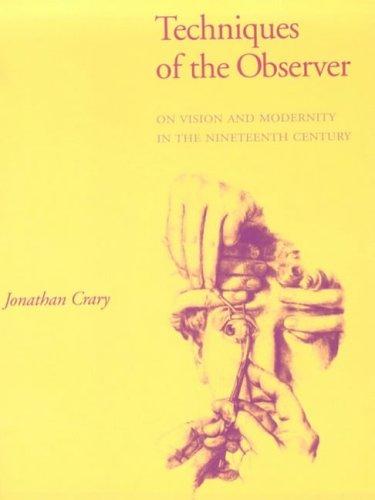
Techniques of the Observer
0
0
As an Amazon Associate and affiliate partner, Menrva Books earns from qualifying purchases. Learn more
Author Description
This text considers the problem of visuality not through the study of art works and images, but by analyzing the historical construction of the observer. The author insists that the problems of vision are inseparable from the operation of social power and examines how, beginning in the 1820s, the observer became the site of new discourses and practices that situated vision within the body as a physiological event. In this context, he examines a range of diverse work in philosophy, in the empirical sciences, and in the elements of an emerging mass visual culture.
Menrva's Summary
THE THESIS
This book investigates the historical construction of the observer and the changing nature of visuality. Jonathan Crary, drawing on his expertise in art history and critical theory, examines how the very concept of seeing has been shaped by social power structures and physiological understandings. He traces this evolution from the 1820s onward, demonstrating how vision became increasingly situated within the body as a biological event, influenced by emerging mass visual culture, philosophical inquiry, and empirical scientific research.
THE SCOPE MAP
- Analysis of the historical construction of the observer, rather than solely art objects.
- Exploration of the relationship between visuality, social power, and the body.
- Examination of discourses and practices that emerged from the 1820s onwards concerning vision.
- Inclusion of diverse works from philosophy and empirical sciences.
- Consideration of the elements of an emerging mass visual culture.
- Focus on vision as a physiological event situated within the body.
THE AUTHORITY PERSPECTIVE
The book is regarded as a seminal work in visual culture studies, offering a rigorous historical analysis of how the act of seeing has been constituted. Scholars often cite Crary's argument that the problems of vision are inseparable from broader social and power dynamics. Its interdisciplinary approach, weaving together philosophy, science, and cultural history, is frequently highlighted as a key strength. The text is considered essential reading for understanding the historical shifts in perception and the modern construction of the visual field.
Page Count:
171
Publication Date:
1990-01-01
ISBN-10:
0262031698
ISBN-13:
9780262031691
Non-Fiction
History
Art
Philosophy
Visual Culture
Art History
Community Tags
Similar Books














