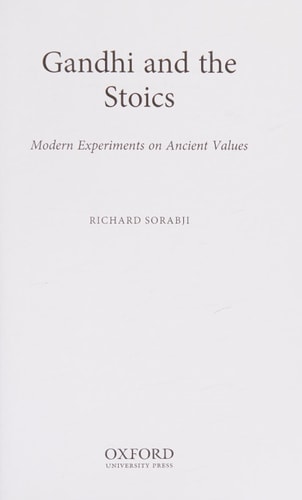
Gandhi and the Stoics: Modern Experiments on Ancient Values
0
0
As an Amazon Associate and affiliate partner, Menrva Books earns from qualifying purchases. Learn more
Author Description
Language: EnglishPages: 238About the BookRichard Sorabji presents a fascinating study of Gandhi's philosophy in comparison with Christian and Stoic thought. Sorabji shows that Gandhi was a true philosopher. He not only aimed to give a consistent self-critical rationale for his views, but also thought himself obliged to live by what he taughtsomething that he had in common with the ancient Greek and Christian ethical traditions. Understanding his philosophy helps with re-assessing the consistency of his positions and life.Gandhi was less influenced by the Stoics than by Socrates, Christ, Christian writers, and Indian thought. But whereas he re-interpreted those, he discovered the congeniality of the Stoics too late to re-process them. They could supply even more of the consistency he sought. He could show them the effect of putting their unrealised ideals into actual practice. Both learnt the indifference of most objectivesthe Stoics from the Cynics, Gandhi from the Bhagavadgita. But both had to square that with their love for all humans and their political engagement. Indifference was to both a source of freedom.Gandhi was converted to non-violence by Tolstoy's picture of Christ. But he addressed the sacrifice it called for, and called even protective killing violent. He was nonetheless not a pacifist, because he recognized the double-bind of rival duties, and the different duties of different individuals, which was a Stoic theme. For both Gandhi and the Stoics it accompanied doubts about universal rules. Sorabji's expert understanding of these ethical traditions allows him to offer illuminating new perspectives on a key intellectual figure of the modern world, and to show the continuing resonance of ancient philosophical ideas.About the AuthorRichard Sorabji is a
Menrva's Summary
THE THESIS
This book investigates the philosophical consistency of Mahatma Gandhi by comparing his ethical framework with the traditions of Stoicism, Socratic thought, and Christian ethics. Richard Sorabji, a renowned scholar of ancient philosophy, utilizes his deep expertise in Greek and Roman thought to analyze Gandhi's life and writings. He argues that Gandhi functioned as a true philosopher who demanded that his actions align with his intellectual principles. By examining these parallels, the author provides a rigorous assessment of how Gandhi navigated complex moral duties and political engagement.
THE SCOPE MAP
What You Will Find
- A comparative analysis of Stoic indifference and the teachings of the Bhagavadgita.
- An examination of the ethical double-binds inherent in political leadership and non-violence.
- A study of the influence of Socrates, Tolstoy, and Christian ethics on Gandhi's development.
- A critical evaluation of the practical application of ancient philosophical ideals in modern political contexts.
THE AUTHORITY PERSPECTIVE
Experts recognize this work as a sophisticated bridge between Eastern political philosophy and Western classical ethics. Readers frequently note the academic density of the prose, which rewards those familiar with both Gandhian studies and ancient philosophical traditions.
Page Count:
176
Publication Date:
2012-11-08
Publisher:
Oxford University Press
ISBN-10:
0199644330
ISBN-13:
9780199644339
Philosophy
Biography
History
Christianity
Stoics
Ethics
Subjects
Community Tags
Similar Books