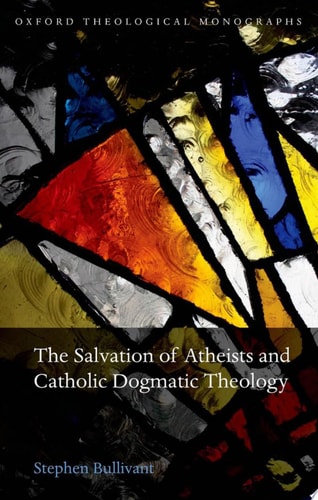
The Salvation of Atheists and Catholic Dogmatic Theology
0
0
As an Amazon Associate and affiliate partner, Menrva Books earns from qualifying purchases. Learn more
Author Description
Since the Second Vatican Council (1962-5), the Catholic Church has formally declared the possibility of salvation for atheists: 'those who, without fault, have not yet arrived at an express recognition of God' (Lumen Gentium 16). However, in the very same document, the Council also reiterates the traditional doctrine of the necessity of faith, baptism, and the mediation of Church in order for someone to be saved (Lumen Gentium 14). This monograph explores how these two seemingly contradictory claims may satisfactorily be reconciled. Specifically, it asks - and ultimately answers - the question: How, within the parameters of Catholic dogmatic theology, is it possible for an atheist to be saved?As the first full-length study of this topic since Vatican II, the book discusses crucial foundational issues - the understanding of 'atheist' in Catholic theology; the developing views on both unbelief, and the salvation of non-Christians, in the decades preceding the Council - before tackling the conciliar teaching itself. Considerable attention is then given to the classic solution of imputing an 'implicit' faith to righteous atheists, best known from Karl Rahner's theory of 'anonymous Christians' (though the basic idea was advocated by many other major figures, including Ratzinger, Schillebeeckx, de Lubac, Balthasar, and Kung). After discussing Rahner's specific proposals in detail, this kind of approach is however shown to be untenable. In its place, a new way of understanding Vatican II's optimism for atheists is developed in detail, in light of scripture, tradition, and magisterium. This draws principally on Christ's descent into Hell, a renewed understanding of invincible ignorance, and a literal interpretation of Matthew 25.
Menrva's Summary
THE THESIS
This monograph investigates the theological possibility of salvation for atheists within the framework of Catholic dogmatic teaching. Stephen Bullivant, a scholar of theology and the sociology of religion, examines the apparent contradiction between the Second Vatican Council's affirmation of salvation for those without explicit faith and the traditional doctrine regarding the necessity of baptism and the Church. By analyzing historical precedents, conciliar documents, and the limitations of existing theories like Karl Rahner's 'anonymous Christians,' the author proposes a new theological model rooted in scripture and tradition.
THE SCOPE MAP
What You Will Find
- Historical development of Catholic perspectives on unbelief and non-Christian salvation.
- Critical analysis of the 'anonymous Christian' theory and its limitations.
- Theological exploration of Christ's descent into Hell and the doctrine of invincible ignorance.
- Re-evaluation of Matthew 25 as a framework for understanding divine judgment.
THE AUTHORITY PERSPECTIVE
Experts recognize this work as a significant contribution to post-Vatican II dogmatic theology. Readers frequently note the academic density of the prose and the rigor with which the author navigates complex ecclesiastical arguments.
Page Count:
256
Publication Date:
2012-06-18
Publisher:
Oxford University Press
ISBN-10:
0199652562
ISBN-13:
9780199652563
Religion
Philosophy
Theology
Catholic Church
Catholicism
Christianity
Salvation
Community Tags
Similar Books