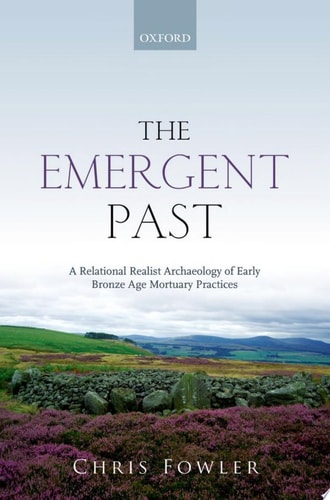
The Emergent Past: A Relational Realist Archaeology of Early Bronze Age Mortuary Practices
0
0
As an Amazon Associate and affiliate partner, Menrva Books earns from qualifying purchases. Learn more
Author Description
The Emergent Past approaches archaeological research as an engagement within an assemblage - a particular configuration of materials, things, places, humans, animals, plants, techniques, technologies, forces, and ideas. Fowler develops a new interpretative method for that engagement, exploring how archaeological research can, and does, reconfigure each assemblage. Recognising the successive relationships that give rise to and reshaped assemblages over time, he proposes a relational realist understanding of archaeological evidence based on a reading of relational and non-representational theories, such as those presented by Karen Barad, Tim Ingold, and Bruno Latour. The volume explores this new approach through the first ever synthesis of Chalcolithic and Early Bronze Age mortuary practices in Northeast England (c.2500-1500 BC), taking into account how different concepts and practices have changed the assemblage of Early Bronze Age mortuary practices in the past 200 years. Fowler argues that it is vital to retain the most valuable archaeological tools, such as typology, while developing an approach that focuses on the contingent, specific, and historical emergence of past phenomena. His study moves from analyses of changing types of mortuary practices and associated things and places, to a vivid discussion of how past relationships unfolded over time and gave rise to specific patterns in the material remains we have today.
Menrva's Summary
THE THESIS
How can archaeological research move beyond traditional representation to engage with the material assemblages of the past? Chris Fowler, a scholar in archaeological theory, utilizes relational and non-representational theories—drawing from the work of Karen Barad, Tim Ingold, and Bruno Latour—to propose a relational realist framework. This approach argues that archaeological evidence is not merely a static record to be interpreted, but an active participant in an ongoing configuration of materials, humans, and ideas that continues to evolve through the act of research itself.
THE SCOPE MAP
What You Will Find
- A comprehensive synthesis of Chalcolithic and Early Bronze Age mortuary practices in Northeast England spanning 2500-1500 BC.
- A methodological framework for relational realism that integrates traditional archaeological tools like typology with contemporary theory.
- Analysis of how the history of archaeological interpretation over the last 200 years has actively reshaped our understanding of these ancient assemblages.
- Case studies examining the relationships between human remains, material objects, and landscape features.
THE AUTHORITY PERSPECTIVE
Experts recognize this work as a significant contribution to archaeological theory, particularly for its attempt to bridge the gap between traditional typological analysis and post-humanist philosophy. Readers frequently note the academic density of the prose, which is intended for scholars and advanced students familiar with contemporary social theory.
Page Count:
352
Publication Date:
2013-12-24
Publisher:
Oxford University Press
ISBN-10:
0199656371
ISBN-13:
9780199656370
History
Methodology
Bronze Age
Archaeology
Anthropology
Copper Age
England
Tombs
Community Tags
Similar Books














