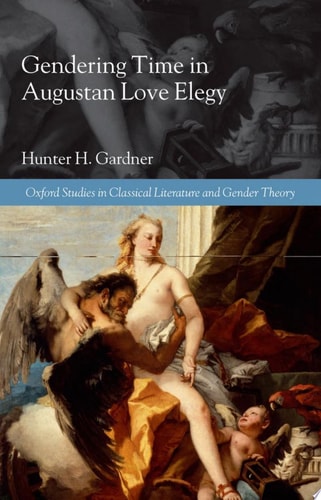
Gendering Time in Augustan Love Elegy
0
0
As an Amazon Associate and affiliate partner, Menrva Books earns from qualifying purchases. Learn more
Author Description
Gendering Time in Augustan Love Elegy examines how and why time appears to affect men and women differently in Latin love elegy. Considering the genre's brief flowering during the Augustan Principate, it aims to situate the elegies of Propertius, Tibullus, and Ovid in their social and political milieu. The volume argues that the imperatives of the new regime, which encouraged a younger generation of loyalists to participate in the machinery of government, placed temporal pressures on the elite male that shaped the amator's (poet-lover's) resistance to enter a course of civil service and prompted his withdrawal into the arms of a courtesan, and therefore unmarriageable, beloved.In the second part of the volume Gardner focuses on the divergent temporal experiences of the amator and his beloved courtesan-puella (girl) through the lens of 'women's time' (le temps des femmes) and the chora, as theorized by psycholinguist Julia Kristeva. Kristeva's model of feminine subjectivity, defined by repetition, cyclicality, and eternity, allows us to understand how the beloved's marginalization from the realm of historical time proves advantageous to her amator, wishing to defer his entrance into civic life. The antithesis between the properties of 'women's time' and the linear momentum that defines masculine subjectivity, moreover, demonstrates how 'women's time' ultimately thwarts the amator's often promised generic evolution.
Menrva's Summary
THE THESIS
This volume investigates how the construction of time in Augustan love elegy functions as a gendered mechanism that reflects the political and social pressures of the Roman Principate. Hunter H. Gardner, a scholar of classical literature, utilizes a framework combining historical context with Julia Kristeva’s theories of feminine subjectivity. By analyzing the works of Propertius, Tibullus, and Ovid, the author argues that the poet-lover’s resistance to civic duty is inextricably linked to his construction of the beloved’s time as cyclical and eternal, contrasting with the linear, state-mandated time of the elite male.
THE SCOPE MAP
What You Will Find
- Analysis of the Augustan Principate's political influence on literary production.
- Application of Julia Kristeva's concepts of 'women's time' and the chora to Latin poetry.
- Comparative study of the amator and the puella as temporal archetypes.
- Examination of the tension between civic service and the withdrawal into private love.
THE AUTHORITY PERSPECTIVE
Scholars in the field of classical studies recognize this work as a significant contribution to the intersection of gender theory and Roman elegy. Readers frequently note the academic density of the prose and the rigor with which Gardner applies modern psychoanalytic frameworks to ancient texts.
Page Count:
304
Publication Date:
2013-04-05
Publisher:
Oxford University Press
ISBN-10:
0199652392
ISBN-13:
9780199652396
History
Criticism history
Literary Criticism
Gender Studies
In literature
Latin
Latin poetry
Community Tags
Other Editions(2)

Similar Books