The Right in France from the Third Republic to Vichy
0
0
As an Amazon Associate and affiliate partner, Menrva Books earns from qualifying purchases. Learn more
Author Description
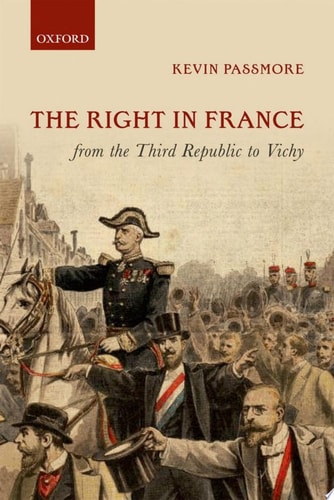
The Right in France from the Third Republic to Vichy provides a new history of parliamentary conservatism and the extreme right in France during the successive crises of the years from 1870 to 1945. In it, Kevin Passmore charts royalist opposition to the newly established Republic, the emergence of the nationalist extreme right in the 1890s, and the parallel development of republican conservatism. He moves on to the hitherto unstudied story of conservatism in during the Great War, and then to the Right's victory in the 1919 elections. Passmore charts the crisis of parliamentary conservatism in the interwar years, and explores the Right's response to the rise of Fascism and Communism. He concludes by placing the Vichy regime, which governed France under the German Occupation, in the context of the history of conservative politics. This history is related to the struggle of those who saw themselves as 'elites' to preserve their leadership in the 'age of the masses'. Passmore shows that conservatives of all stripes shared a common culture (notably including organicism and crowd theory), but that different factions used these ideas in different ways, for different purposes. Whereas previous studies have been primarily concerned to 'categorize' conservatives groups, for example as 'fascist',' liberal', or 'modern', this study examines the way in which competing groups used such terms in complex struggles amongst themselves and with the left. The study is based on considerable archival research, as well as on knowledge of the vast body of recently published research in English and French.
Menrva's Summary
THE THESIS
This work investigates how French conservative and extreme-right political factions navigated the transition from the Third Republic to the Vichy regime between 1870 and 1945. Kevin Passmore, a specialist in French political history, utilizes extensive archival research and contemporary scholarship to challenge traditional categorizations of the Right. He argues that rather than static ideological labels, these groups were defined by a shared culture of organicism and crowd theory, which they adapted to maintain elite leadership during the rise of mass politics.
THE SCOPE MAP
What You Will Find
- A chronological analysis of French parliamentary conservatism from the post-1870 era through the German Occupation.
- An examination of the ideological evolution of the extreme right, including its response to Fascism and Communism.
- A methodological shift from labeling political groups to analyzing how they used political terminology in internal power struggles.
- Evidence derived from primary archival sources and a synthesis of English and French academic literature.
THE AUTHORITY PERSPECTIVE
Scholars recognize this text as a significant contribution to the study of French political history, particularly for its nuanced approach to the internal dynamics of the Right. Readers frequently note the academic density of the prose, which provides a rigorous framework for understanding the complexities of interwar French politics.
Page Count:
368
Publication Date:
2013-01-06
Publisher:
Oxford University Press
ISBN-10:
019965820X
ISBN-13:
9780199658206
History
European History
Twentieth Century
Conservatism
French History
Right and left Political science