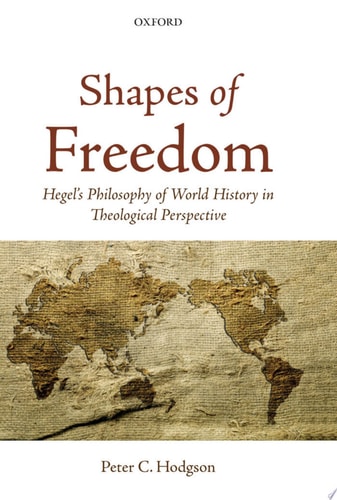
Shapes of Freedom: Hegel's Philosophy of World History in Theological Perspective
0
0
As an Amazon Associate and affiliate partner, Menrva Books earns from qualifying purchases. Learn more
Author Description
Peter C. Hodgson explores Hegel's bold vision of history as the progress of the consciousness of freedom. Following an introductory chapter on the textual sources, the key categories, and the modes of writing history that Hegel distinguishes, Hodgson presents a new interpretation of Hegel's conception of freedom. Freedom is not simply a human production, but takes shape through the interweaving of the divine idea and human passions, and such freedom defines the purpose of historical events in the midst of apparent chaos. Freedom is also a process that unfolds through stages of historical/cultural development and is oriented to an end that occurs within history (the 'kingdom of freedom'). The purpose and the process of history are tragic, however, because history is also a 'slaughterhouse' that shatters even the finest human creations and requires a constant rebuilding. Hegel's God is not a supreme being or 'large entity' but the 'true infinite' that encompasses the finite. History manifests the rule of God ('providence'), and it functions as the justification of God ('theodicy'). But the God who rules in and is justified by history is a crucified God who takes the suffering, anguish, and evil of the world into and upon godself, accomplishing reconciliation in the midst of ongoing estrangement and inescapable death. Shapes of Freedom addresses these themes in the context of present-day questions about what they mean and whether they still have validity.
Menrva's Summary
THE THESIS
This work investigates whether Hegel's philosophy of world history, centered on the progress of freedom, retains validity and meaning within a contemporary theological framework. Peter C. Hodgson, a scholar of Hegelian thought, examines the intersection of divine providence and human historical action. He argues that Hegel's conception of freedom is not merely a human construct but a complex interplay between the divine idea and human passion, ultimately functioning as a theodicy that addresses the presence of suffering and evil in the world.
THE SCOPE MAP
What You Will Find
- An analysis of Hegel's primary textual sources and historical writing methodologies.
- A theological reinterpretation of the 'true infinite' and its relationship to finite historical events.
- Examination of the 'slaughterhouse' of history and the concept of the crucified God.
- Discussion on the 'kingdom of freedom' as an end-oriented process within historical development.
THE AUTHORITY PERSPECTIVE
Scholars recognize this text as a significant contribution to the intersection of Hegelian philosophy and systematic theology. Readers frequently note the academic density of the prose, which requires a foundational understanding of both German Idealism and Christian theology to fully grasp the author's arguments.
Page Count:
208
Publication Date:
2012-05-18
Publisher:
Oxford University Press
ISBN-10:
0199654956
ISBN-13:
9780199654956
History
Non-Fiction
Philosophy
Religion
History
Philosophy & Religion
Theology
God attributes
Community Tags
Similar Books