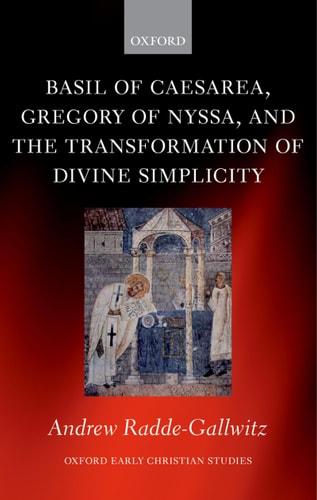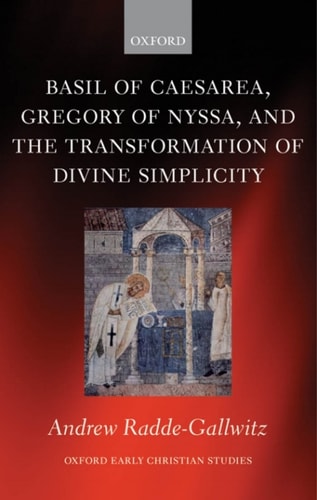
Basil of Caesarea, Gregory of Nyssa, and the Transformation of Divine Simplicity
0
0
As an Amazon Associate and affiliate partner, Menrva Books earns from qualifying purchases. Learn more
Author Description
Divine simplicity is the idea that, as the ultimate principle of the universe, God must be a non-composite unity not made up of parts or diverse attributes. The idea was appropriated by early Christian theologians from non-Christian philosophy and played a pivotal role in the development of Christian thought. Andrew Radde-Gallwitz charts the progress of the idea of divine simplicity from the second through the fourth centuries, with particular attention to Basil of Caesarea and Gregory of Nyssa, two of the most subtle writers on this topic, both instrumental in the construction of the Trinitarian doctrine proclaimed as orthodox at the Council of Constantinople in 381. He demonstrates that divine simplicity was not a philosophical appendage awkwardly attached to the early Christian doctrine of God, but a notion that enabled Christians to articulate the consistency of God as portrayed in their scriptures. Basil and Gregory offered a unique construal of simplicity in responding to their principal doctrinal opponent, Eunomius of Cyzicus. Challenging accepted interpretations of the Cappadocian brothers and the standard account of divine simplicity in recent philosophical literature, Radde-Gallwitz argues that Basil and Gregory's achievement in transforming ideas inherited from the non-Christian philosophy of their time has an ongoing relevance for Christian theological epistemology today.
Menrva's Summary
THE THESIS
This work investigates how the concept of divine simplicity evolved from a philosophical abstraction into a foundational element of early Christian Trinitarian theology. Andrew Radde-Gallwitz, a scholar of patristic thought, examines the intellectual contributions of Basil of Caesarea and Gregory of Nyssa. By analyzing their responses to Eunomius of Cyzicus, the author argues that these theologians did not merely adopt Greek philosophical concepts but actively transformed them to align with scriptural consistency and the emerging doctrine of the Trinity.
THE SCOPE MAP
What You Will Find
- Historical analysis of divine simplicity from the second to the fourth centuries.
- Detailed examination of the theological conflict between the Cappadocian Fathers and Eunomius of Cyzicus.
- A re-evaluation of the role of philosophical synthesis in the construction of orthodox Trinitarian doctrine.
Scope Limits
- The study focuses primarily on the specific contributions of Basil and Gregory rather than a comprehensive history of all early Christian thinkers.
- The text assumes a high level of familiarity with patristic literature and technical philosophical terminology.
THE AUTHORITY PERSPECTIVE
Scholars in the field of patristics recognize this text as a significant intervention in the study of Cappadocian theology and its relationship to Greek philosophy. Readers frequently note the academic density of the prose, which is intended for advanced students and researchers of early Christian thought.
Page Count:
272
Publication Date:
2009-01-01
Publisher:
Oxford University Press
ISBN-10:
0191571997
ISBN-13:
9780191571992
Philosophy
Religion
God attributes
Patristics
Metaphysics
Theology
Christian History