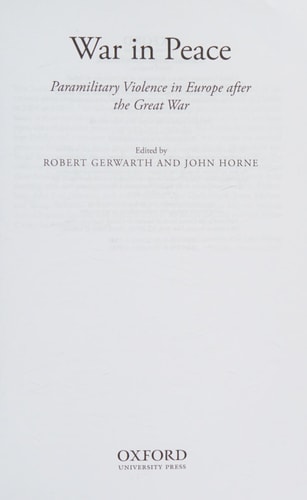
War in Peace: Paramilitary Violence in Europe after the Great War
0
0
As an Amazon Associate and affiliate partner, Menrva Books earns from qualifying purchases. Learn more
Author Description
The First World War did not end in November 1918. In Russia and Eastern Europe it finished up to a year earlier, and both there and elsewhere in Europe it triggered conflicts that lasted down to 1923. Paramilitary formations were prominent in this continuation of the war. They had some features of formal military organizations, but were used in opposition to the regular military as an instrument of revolution or as an adjunct or substitute for military forces when these were unable by themselves to put down a revolution (whether class or national). Paramilitary violence thus arose in different contexts. It was an important aspect of the violence unleashed by class revolution in Russia. It structured the counter-revolution in central and Eastern Europe, including Finland and Italy, which reacted against a mythic version of Bolshevik class violence in the name of order and authority. It also shaped the struggles over borders and ethnicity in the new states that replaced the multi-national empires of Russia, Austria-Hungary and Ottoman Turkey. It was prominent on all sides in the wars for Irish independence. In many cases, paramilitary violence was charged with political significance and acquired a long-lasting symbolism and influence.War in Peace explores the differences and similarities between these various kinds of paramilitary violence within one volume for the first time. It thereby contributes to our understanding of the difficult transitions from war to peace. It also helps to re-situate the Great War in a longer-term context and to explain its enduring impact.
Menrva's Summary
THE THESIS
This work investigates how paramilitary violence served as a critical, often overlooked mechanism in the transition from the First World War to the subsequent period of instability across Europe. Robert Gerwarth and John N. Horne, both established scholars in modern European history, synthesize extensive research to argue that the Great War did not conclude in 1918 but rather evolved into a series of localized, violent conflicts lasting until 1923. They present a comparative framework that links the collapse of multi-national empires with the rise of irregular military formations used for both revolutionary and counter-revolutionary ends.
THE SCOPE MAP
What You Will Find
- Analysis of paramilitary activity in Russia, Finland, Italy, and the newly formed states of Eastern Europe.
- Examination of the role of irregular forces in the Irish War of Independence.
- Comparative study of class-based revolutionary violence versus nationalist border conflicts.
- Assessment of the political symbolism and long-term societal impact of paramilitary organizations.
THE AUTHORITY PERSPECTIVE
Historians and scholars of the interwar period frequently cite this text as a foundational study for understanding the continuity of violence in post-1918 Europe. The prose is noted for its academic rigor and its ability to synthesize complex regional conflicts into a cohesive, continent-wide narrative.
Page Count:
240
Publication Date:
2012-12-12
Publisher:
Oxford University Press
ISBN-10:
0199654913
ISBN-13:
9780199654918
History
Armies
Twentieth Century
European History
Military History
Europe
Community Tags
Similar Books