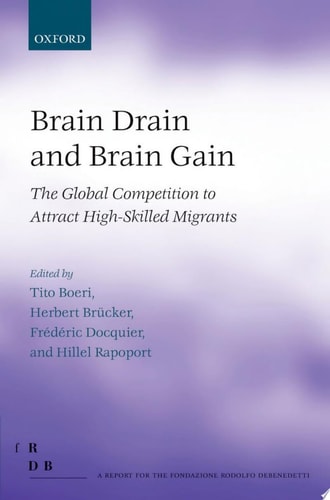
Brain Drain and Brain Gain: The Global Competition to Attract High-Skilled Migrants
0
0
As an Amazon Associate and affiliate partner, Menrva Books earns from qualifying purchases. Learn more
Author Description
The worldwide race to attract talents is getting tougher. The US has been leading the race, with its ability to attract PhD candidates and graduates not only from emerging countries, but also from the European Union. However, a growing number of countries have adopted immigration policies specifically aimed at selecting and attracting skilled workers. This book describes the global competition to attract talents. It focuses in particular on two phenomena: the brain gain and brain drain associated with high-skilled migration.Part I provides an overview of immigration policies designed to draw in skilled workers. It describes the economic gains associated with skilled immigration in the destination countries and the main determinants of the inflows of skilled immigrants (such as wage premia on education and R&D spending). It also discusses why skill-selective immigration policies do not find more support in receiving countries and shows that interest groups are actively engaged in affecting policies towards skilled migrants. Part II examines the consequences of brain drain for the sending countries. It reviews the channels through which skilled emigration can affect the source countries and looks at remittances, return migration, diaspora externalities, and network effects that may compensate the sending countries for their loss of human capital. Contrary to traditional wisdom, the results indicate that most developing countries experience a net gain from skilled emigration.
Menrva's Summary
THE THESIS
This book investigates the economic and social dynamics of the global competition for high-skilled labor, specifically analyzing the dual phenomena of brain drain and brain gain. The authors, a team of expert economists, utilize empirical data and policy analysis to evaluate how immigration frameworks in developed nations impact both the destination countries and the source nations. By examining wage premia, R&D investment, and migration policy, the text provides a comprehensive framework for understanding the movement of human capital in a globalized economy.
THE SCOPE MAP
What You Will Find
- Comparative analysis of immigration policies designed to attract skilled workers across various nations.
- Economic assessment of the impact of skilled migration on destination country labor markets.
- Evaluation of remittances, return migration, and network effects as compensatory mechanisms for source countries.
- Discussion of political economy factors, including interest group influence on immigration legislation.
THE AUTHORITY PERSPECTIVE
Experts recognize this report as a foundational text for understanding the nuances of human capital mobility in modern economics. Readers frequently note the academic density of the prose and the rigorous empirical approach taken by the authors to challenge traditional assumptions regarding the negative impacts of emigration on developing nations.
Page Count:
336
Publication Date:
2012-09-29
Publisher:
Oxford University Press
ISBN-10:
0199654824
ISBN-13:
9780199654826
Economics
Sociology
Public Policy
Brain Drain
Labor Mobility
International relations
Migration
Skilled Labor
Community Tags
Similar Books