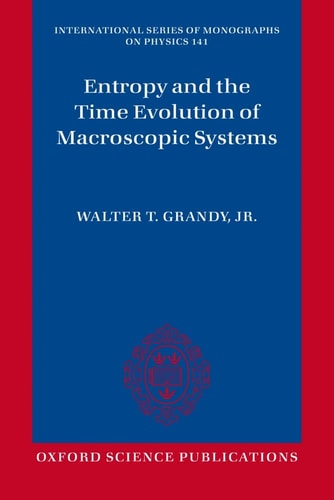
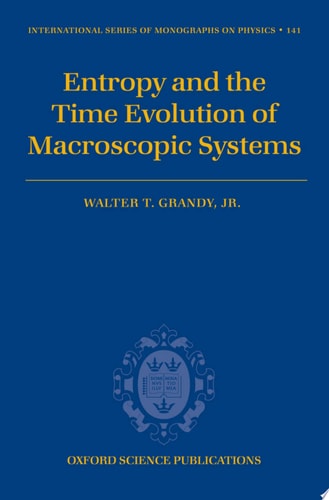
Entropy and the Time Evolution of Macroscopic Systems
0
0
As an Amazon Associate and affiliate partner, Menrva Books earns from qualifying purchases. Learn more
Author Description
This book is based on the premise that the entropy concept, a fundamental element of probability theory as logic, governs all of thermal physics, both equilibrium and nonequilibrium. The variational algorithm of J. Willard Gibbs, dating from the 19th Century and extended considerably over the following 100 years, is shown to be the governing feature over the entire range of thermal phenomena, such that only the nature of the macroscopic constraints changes. Beginning with a short history of the development of the entropy concept by Rudolph Clausius and his predecessors, along with the formalization of classical thermodynamics by Gibbs, the first part of the book describes the quest to uncover the meaning of thermodynamic entropy, which leads to its relationship with probability and information as first envisioned by Ludwig Boltzmann. Recognition of entropy first of all as a fundamental element of probability theory in mid-twentieth Century led to deep insights into both statistical mechanics and thermodynamics, the details of which are presented here in several chapters. The later chapters extend these ideas to nonequilibrium statistical mechanics in an unambiguous manner, thereby exhibiting the overall unifying role of the entropy.
Menrva's Summary
THE THESIS
This book investigates whether the concept of entropy, when viewed as a fundamental element of probability theory, serves as the governing principle for all thermal physics. Walter T. Grandy Jr. utilizes the historical development of thermodynamics and the variational algorithm of J. Willard Gibbs to construct a unified framework. By bridging classical thermodynamics with modern information theory, the author argues that entropy acts as a consistent logical constraint across both equilibrium and nonequilibrium macroscopic systems.
THE SCOPE MAP
What You Will Find
- Historical development of the entropy concept from Clausius to Boltzmann
- Formalization of the variational algorithm of J. Willard Gibbs
- Application of probability theory as logic to thermal phenomena
- Extension of statistical mechanics principles to nonequilibrium systems
THE AUTHORITY PERSPECTIVE
Experts recognize this text as a rigorous examination of the logical foundations of statistical mechanics. Readers frequently note the high level of mathematical and conceptual density, making it a specialized resource for advanced students and researchers in theoretical physics.
Page Count:
224
Publication Date:
2012-07-22
Publisher:
Oxford University Press
ISBN-10:
019965543X
ISBN-13:
9780199655434
Science
Statistical mechanics
Academic
Physics
Information Theory
Thermodynamics
Community Tags
Other Editions(3)
Similar Books