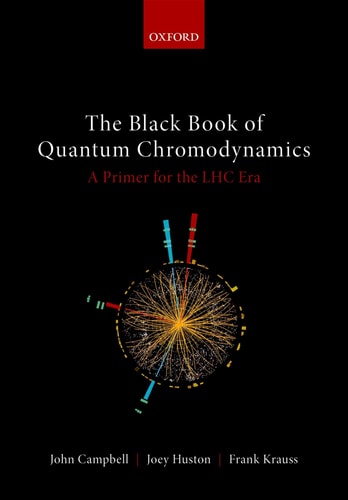
The Black Book of Quantum Chromodynamics: A Primer for the LHC Era
0
0
As an Amazon Associate and affiliate partner, Menrva Books earns from qualifying purchases. Learn more
Author Description
This is an open access title. It is available to read and download as a free PDF version on Oxford Academic and is made available under a Creative Commons Attribution 4.0 licence.The Black Book of Quantum Chromodynamics is an in-depth introduction to the particle physics of current and future experiments at particle accelerators. The book offers the reader an overview of practically all aspects of the strong interaction necessary to understand and appreciate modern particle phenomenology at the energy frontier. It assumes a working knowledge of quantum field theory at the level of introductory textbooks used for advanced undergraduate or in standard postgraduate lectures. The book expands this knowledge with an intuitive understanding of relevant physical concepts, an introduction to modern techniques, and their application to the phenomenology of the strong interaction at the highest energies. Aimed at graduate students and researchers, it also serves as a comprehensive reference for LHC experimenters and theorists.This book offers an exhaustive presentation of the technologies developed and used by practitioners in the field of fixed-order perturbation theory and an overview of results relevant for the ongoing research programme at the LHC. It includes an in-depth description of various analytic resummation techniques, which form the basis for our understanding of the QCD radiation pattern and how strong production processes manifest themselves in data, and a concise discussion of numerical resummation through parton showers, which form the basis of event generators for the simulation of LHC physics, and their matching and merging with fixed-order matrix elements. It also gives a detailed presentation of the physics behind the parton distribution functions, which are a necessary ingredient for every calculation relevant for physics at hadron colliders such as the LHC, and an introduction to non-perturbative aspects of the strong interaction, including inclusive observables such as total and elastic cross sections, and non-trivial effects such as multiple parton interactions and hadronization. The book concludes with a useful overview contextualising data from previous experiments such as the Tevatron and the Run I of the LHC which have shaped our understanding of QCD at hadron colliders.
Menrva's Summary
THE THESIS
This text investigates the complex phenomenology of the strong interaction, specifically addressing the theoretical and practical requirements for interpreting data from high-energy particle accelerators like the Large Hadron Collider (LHC). The authors, John Campbell, Frank Krauss, and Joey Huston, leverage their extensive expertise in particle physics to synthesize advanced quantum field theory concepts into a cohesive framework. By bridging the gap between introductory theory and experimental application, the book provides a rigorous foundation for understanding how strong production processes manifest in modern collider experiments.
THE SCOPE MAP
What You Will Find
- Comprehensive analysis of fixed-order perturbation theory and its application to LHC research.
- Detailed examination of analytic resummation techniques and their role in modeling QCD radiation patterns.
- Technical overview of numerical resummation through parton showers and event generator simulation.
- In-depth study of parton distribution functions and non-perturbative aspects of the strong interaction.
THE AUTHORITY PERSPECTIVE
Experts identify this work as a foundational reference for graduate students and researchers actively engaged in LHC physics. Readers frequently note the high level of technical density, which assumes a prior working knowledge of quantum field theory.
Page Count:
768
Publication Date:
2018-02-14
Publisher:
Oxford University Press
ISBN-10:
0199652740
ISBN-13:
9780199652747
Science
Academic
Physics
Particle Physics
Community Tags
Other Editions(4)
Similar Books







Reader Comments
Share Your Thoughts
No comments yet. Be the first to share your thoughts!