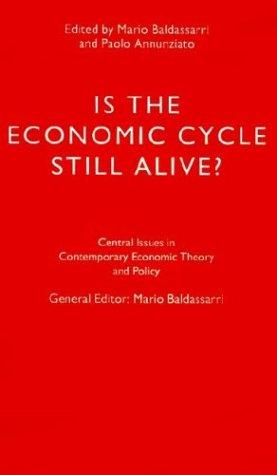
Is the Economic Cycle Still Alive?
0
0
As an Amazon Associate and affiliate partner, Menrva Books earns from qualifying purchases. Learn more
Author Description
Interest in the analysis and measurement of economic fluctuations would appear to have its own cyclical trend, being strong and common during and after periods of considerable instability but more neglected during periods of continuous growth. Similarly, in the evolution of economic theory, periods of intense research into the origins of the cycle have alternated with periods of great confidence in the ability of economic policy to reduce economic instability. In particular, during the 1960s and the early 1970s, the fiscal authorities of almost all the industrialised countries and international economic institutes were busily engaged in 'fine tuning' the economy, in accordance with the dictates of Keynesian economics. We are now living what can only be another period of disillusion in the ability of economic policy, be it monetary or fiscal, to stabilise the economy. This is proven by the onset of severe recessions in various parts of the world during the first half of the 1980s and the inability to invert the negative phase of the business cycle under way in the various industrial countries in the early 1990s. As a consequence of the failure of old solutions there is a need for the detailed research into the causes of economic fluctuations and their measurement presented in this collection of papers. The first section of the volume deals with recent developments in contemporary empirical macroeconomics and debates the causes of the high degree of serial correlation in economic time series. The second section concentrates on methods for measuring the business cycle for forecasting purposes. The volume closes by surveying the main problems of the business-cycle analysis in a paper dealing with the 'cycle' of the business-cycle theory, that is to say the fortune and misfortunes this approach has encountered over the years.
Menrva's Summary
THE THESIS
This book investigates whether the concept of the economic cycle, a fundamental element of macroeconomic theory, remains relevant and observable in contemporary economies. The author, Mario Baldassarri, addresses the cyclical nature of interest in economic fluctuations, noting its resurgence during periods of instability and neglect during growth. The work is motivated by a disillusionment with the efficacy of monetary and fiscal policies in stabilizing economies, as evidenced by recessions in the 1980s and early 1990s. The collection of papers aims to provide detailed research into the causes and measurement of economic fluctuations, challenging the prevailing assumptions about economic policy's stabilizing power.
THE SCOPE MAP
- Recent developments in contemporary empirical macroeconomics.
- Debates on the causes of high serial correlation in economic time series.
- Methods for measuring the business cycle for forecasting purposes.
- A survey of the main problems in business-cycle analysis.
- An examination of the historical 'cycle' of business-cycle theory itself.
THE AUTHORITY PERSPECTIVE
This collection of papers addresses the enduring relevance of economic cycle theory in the face of policy disillusionment. It delves into empirical macroeconomics and measurement techniques for forecasting, offering a critical perspective on the historical trajectory of business-cycle analysis. The work is positioned as a response to the perceived failures of economic policy in the late 20th century, suggesting a need for renewed research into the fundamental causes of economic fluctuations.
Page Count:
303
Publication Date:
1994-01-01
ISBN-10:
0312103808
Non-Fiction
History
Business
Economics
Community Tags
Similar Books