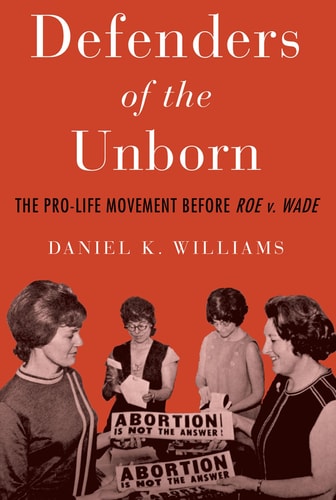
Defenders of the Unborn: The Pro-Life Movement before Roe v. Wade
0
0
As an Amazon Associate and affiliate partner, Menrva Books earns from qualifying purchases. Learn more
Author Description
On April 16, 1972, ten thousand people gathered in Central Park to protest New York's liberal abortion law. Emotions ran high, reflecting the nation's extreme polarization over abortion. Yet the divisions did not fall neatly along partisan or religious lines-the assembled protesters were far from a bunch of fire-breathing culture warriors. In Defenders of the Unborn, Daniel K. Williams reveals the hidden history of the pro-life movement in America, showing that a cause that many see as reactionary and anti-feminist began as a liberal crusade for human rights.For decades, the media portrayed the pro-life movement as a Catholic cause, but by the time of the Central Park rally, that stereotype was already hopelessly outdated. The kinds of people in attendance at pro-life rallies ranged from white Protestant physicians, to young mothers, to African American Democratic legislators-even the occasional member of Planned Parenthood. One of New York City's most vocal pro-life advocates was a liberal Lutheran minister who was best known for his civil rights activism and his protests against the Vietnam War. The language with which pro-lifers championed their cause was not that of conservative Catholic theology, infused with attacks on contraception and women's sexual freedom. Rather, they saw themselves as civil rights crusaders, defending the inalienable right to life of a defenseless minority: the unborn fetus. It was because of this grounding in human rights, Williams argues, that the right-to-life movement gained such momentum in the early 1960s. Indeed, pro-lifers were winning the battle before Roe v. Wade changed the course of history.Through a deep investigation of previously untapped archives, Williams presents the untold story of New Deal-era liberals who forged alliances with a diverse array of activists, Republican and Democrat alike, to fight for what they saw as a human rights cause. Provocative and insightful, Defenders of the Unborn is a must-read for anyone wh
Menrva's Summary
THE THESIS
This book investigates the origins and ideological foundations of the American pro-life movement prior to the 1973 Supreme Court decision in Roe v. Wade. Daniel K. Williams, a historian specializing in American political and religious history, utilizes previously untapped archival materials to challenge the conventional narrative that the movement was exclusively a conservative, Catholic-led reaction. He argues that the movement initially emerged as a liberal-leaning crusade for human rights, drawing support from a diverse coalition that included civil rights activists, Protestant clergy, and secular progressives who viewed the protection of the unborn as an extension of broader human rights advocacy.
THE SCOPE MAP
What You Will Find
- Historical analysis of the pro-life movement from the New Deal era through the early 1970s.
- Examination of the diverse demographic and political backgrounds of early pro-life activists.
- Documentation of the rhetorical strategies used to frame abortion as a human rights violation.
Scope Limits
- The text does not provide a comprehensive history of the abortion rights movement or the post-Roe political landscape.
- The analysis focuses primarily on the American context and does not address international developments in reproductive law.
THE AUTHORITY PERSPECTIVE
Historians and political scientists frequently cite this work for its rigorous archival research and its ability to complicate the standard partisan narrative surrounding reproductive politics. Scholars note that the text provides a necessary corrective to the assumption that the pro-life movement was always aligned with conservative religious factions.
Page Count:
400
Publication Date:
2019-05-01
Publisher:
Oxford University Press
ISBN-10:
0190053321
ISBN-13:
9780190053321
Politics
History
Religion
Womens Issues
Christian Living
Womens Studies
Religious Aspects
Human rights
American History
Special Topics
New Used & Rental Textbooks
Politics & Government
Moral and ethical aspects
Americas
Abortion Rights
Social Issues
American Government
United States
Community Tags
Similar Books