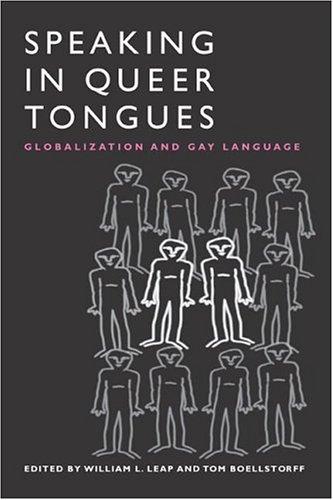
Speaking in Queer Tongues
0
0
As an Amazon Associate and affiliate partner, Menrva Books earns from qualifying purchases. Learn more
Author Description
Language is a fundamental tool for shaping identity and community, including the expression (or repression) of sexual desire. Speaking in Queer Tongues investigates the tensions and adaptations that occur when processes of globalization bring one system of gay or lesbian language into contact with another. Western constructions of gay culture are now circulating widely beyond the boundaries of Western nations due to influences as diverse as Internet communication, global dissemination of entertainment and other media, increased travel and tourism, migration, displacement, and transnational citizenship. The authority claimed by these constructions, and by the linguistic codes embedded in them, is causing them to have a profound impact on public and private expressions of homosexuality in locations as diverse as sub-Saharan Africa, New Zealand, Indonesia and Israel. Examining a wide range of global cultures, Speaking in Queer Tongues presents essays on topics that include old versus new sexual vocabularies, the rhetoric of gay-oriented magazines and news media, verbal and nonverbalized sexual imagery in poetry and popular culture, and the linguistic consequences of the globalized gay rights movement.
Menrva's Summary
THE THESIS
This book examines the complex interplay between language, identity, and sexuality in a globalized world. It investigates how Western notions of gay and lesbian identity, disseminated through various media and social forces, are impacting local expressions of homosexuality across diverse cultures. The essays explore the linguistic adaptations and tensions that arise when different gay or lesbian language systems encounter each other, challenging and reshaping understandings of sexual identity on a global scale.
THE SCOPE MAP
- Analysis of the impact of globalization on gay and lesbian language systems worldwide.
- Case studies from diverse global regions including sub-Saharan Africa, New Zealand, Indonesia, and Israel.
- Examination of the rhetoric and linguistic codes within gay-oriented magazines and news media.
- Exploration of verbal and nonverbal sexual imagery in poetry and popular culture.
- Discussion of the linguistic consequences of the globalized gay rights movement.
- Investigation into the evolution of sexual vocabularies in different cultural contexts.
THE AUTHORITY PERSPECTIVE
The book is recognized for its comprehensive exploration of how language shapes queer identities in an increasingly interconnected world. Scholars and readers have noted its insightful analysis of the global dissemination of Western gay culture and its subsequent impact on local sexual vocabularies and expressions. The collection is valued for its diverse case studies, offering a nuanced understanding of the linguistic adaptations occurring across various international contexts. It serves as a significant contribution to the fields of sociolinguistics and queer studies, highlighting the dynamic relationship between language, globalization, and sexuality.
Page Count:
288
Publication Date:
2004-01-01
ISBN-10:
0252028716
Literary Fiction
Non-Fiction
Globalization
Queer Studies
Cultural Anthropology
Community Tags
Similar Books