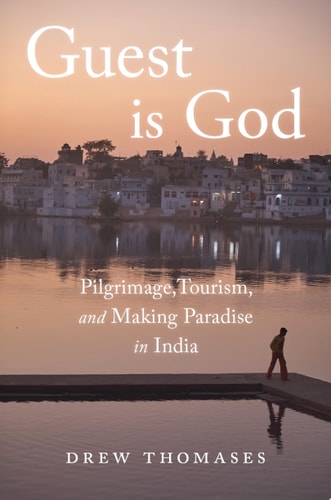
Guest is God: Pilgrimage, Tourism, and Making Paradise in India
0
0
As an Amazon Associate and affiliate partner, Menrva Books earns from qualifying purchases. Learn more
Author Description
Every year, the Indian pilgrimage town of Pushkar sees its population of 20,000 swell by two million visitors. Since the 1970s, Pushkar, which is located about 250 miles southwest of the capital of New Delhi, has received considerable attention from international tourists. Originally hippies and backpackers, today's visitors now come from a wide range of social positions. To locals, though, Pushkar is more than just a gathering place for pilgrims and tourists: it is where Brahma, the creator god, made his home; it is where Hindus should feel blessed to stay, if only for a short time; and it is where locals would feel lucky to be reborn, if only as a pigeon. In short, it is their paradise. But even paradise needs upkeep. In Guest is God, Drew Thomases uses ethnographic fieldwork to explore the massive enterprise of building heaven on earth. The articulation of sacred space necessarily works alongside economic changes brought on by tourism and globalization. Here the contours of what actually constitutes paradise are redrawn by developments in, and the agents of, tourism. And as paradise is made and remade, people in Pushkar help to create a brand of Hindu religion that is tailored to its local surroundings while also engaging global ideas. The goal, then, becomes to show how religion and tourism can be mutually constitutive.
Menrva's Summary
THE THESIS
This book investigates how the intersection of religious pilgrimage and international tourism transforms the Indian town of Pushkar into a constructed, modern paradise. Drew Thomases, an anthropologist, utilizes extensive ethnographic fieldwork conducted within the town to analyze the complex relationship between sacred space and global economic forces. He argues that the local population actively shapes a specific brand of Hinduism that simultaneously honors traditional theological significance and adapts to the demands of a globalized visitor economy.
THE SCOPE MAP
What You Will Find
- Ethnographic analysis of the town of Pushkar, India
- Examination of the economic impact of tourism on religious sites
- Theoretical framework on the mutual constitution of religion and tourism
Scope Limits
- The study focuses primarily on the specific case of Pushkar rather than providing a comprehensive survey of all Indian pilgrimage sites
- The text does not offer a historical account of pre-1970s tourism in the region
THE AUTHORITY PERSPECTIVE
Scholars in religious studies and anthropology recognize this work as a significant contribution to the understanding of how sacred spaces adapt to global market pressures. Readers frequently note the academic rigor of the ethnographic data and the clarity with which the author navigates the tension between spiritual devotion and commercial enterprise.
Page Count:
224
Publication Date:
2019-01-01
Publisher:
Oxford University Press
ISBN-10:
019088357X
ISBN-13:
9780190883577
Religion
Cultural Anthropology
General Anthropology
India
India religion
Hinduism
Anthropology
Globalization
Tourism Studies
Sociology
Community Tags
Similar Books