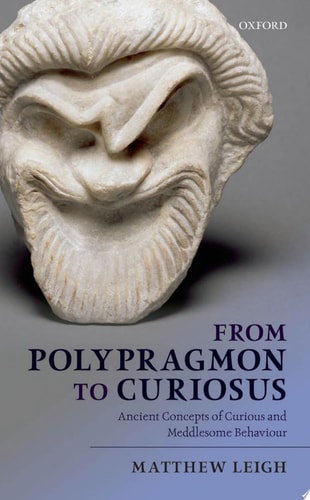
From Polypragmon to Curiosus: Ancient Concepts of Curious and Meddlesome
0
0
As an Amazon Associate and affiliate partner, Menrva Books earns from qualifying purchases. Learn more
Author Description
From Polypragmon to Curiosus is a study of how Greek and Latin writers describe curious, meddlesome, and exaggerated behavior. Founded on a detailed investigation of a family of Greek terms, often treated as synonymous with each other, and of the Latin words used to describe them, opening chapters survey how they were used in Greek literature from the 5th and 4th centuries BC, moving onto their Latin usage and relationship to that of Hellenistic and imperial Greek. Other chapters adopt a more thematic approach and consider how words, such as polypramon, periergos, philopragmon, and curiosus, are employed in descriptions of the world of knowledge opened up by empire - in discourses of pious and impious curiosity, in reflections on what constitutes useful and useless learning, and in descriptions of style.The themes which the volume addresses remain alive throughout the literature of the Middle Ages and the Renaissance, most obviously through emblematic figures of human curiosity, such as Dante's Ulisse and Marlowe's Dr Faustus.
Menrva's Summary
THE THESIS
This volume investigates the evolution of ancient concepts regarding curiosity and meddlesomeness through the linguistic analysis of Greek and Latin terminology. Matthew Leigh, a scholar of classical literature, examines how terms like polypragmon and curiosus shifted in meaning and application from the 5th century BC through the Roman imperial period. By tracing these semantic changes, the author argues that these concepts were central to ancient debates concerning the boundaries of knowledge, the utility of learning, and the moral implications of intellectual inquiry.
THE SCOPE MAP
What You Will Find
- A diachronic analysis of Greek terms including polypragmon, periergos, and philopragmon.
- An examination of the transition from Greek usage to Latin equivalents like curiosus.
- Thematic exploration of curiosity within the context of imperial expansion and religious discourse.
- Connections between ancient definitions of curiosity and later literary archetypes in the Middle Ages and Renaissance.
THE AUTHORITY PERSPECTIVE
Scholars recognize this work as a rigorous philological study that clarifies the nuanced development of classical intellectual history. Experts highlight the book's utility for those interested in the intersection of ancient linguistics and the history of ideas.
Page Count:
272
Publication Date:
2013-06-10
Publisher:
Oxford University Press
ISBN-10:
0199668612
ISBN-13:
9780199668618
History
Philosophy
American History
Literary Criticism
Linguistics
Community Tags
Similar Books














