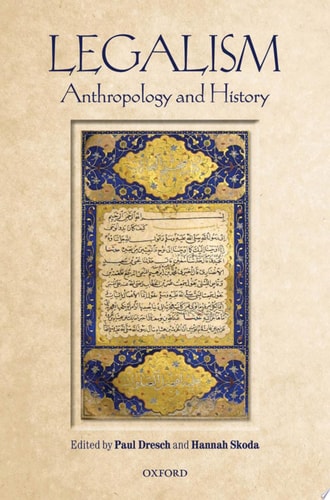
Legalism: Anthropology and History
0
0
As an Amazon Associate and affiliate partner, Menrva Books earns from qualifying purchases. Learn more
Author Description
Law and law-like institutions are visible in human societies very distant from each other in time and space. When it comes to observing and analyzing such social constructs historians, anthropologists, and lawyers run into notorious difficulties in how to conceptualize them. Do they conform to a single category of 'law'? How are divergent understandings of the nature and purpose of law to be described and explained? Such questions reach to the heart of philosophical attempts to understand the nature of law, but arise whenever we are confronted by law-like practices and concepts in societies not our own.In this volume leading historians and anthropologists with an interest in law gather to analyse the nature and meaning of law in diverse societies. They start from the concept of legalism, taken from the anthropologist Lloyd Fallers, whose 1960s work on Africa engaged, unusually, with jurisprudence. The concept highlights appeal to categories and rules. The degree to which legalism in this sense informs people's lives varies within and between societies, and over time, but it can colour equally both 'simple' and 'complex' law. Breaking with recent emphases on 'practice', nine specialist contributors explore, in a wide-ranging set of cases, the place of legalism in the workings of social life.The essays make obvious the need to question our parochial common sense where ideals of moral order at other times and places differ from those of modern North Atlantic governance. State-centred law, for instance, is far from a 'central case'. Legalism may be 'aspirational', connecting people to wider visions of morality; duty may be as prominent a theme as rights; and rulers from thirteenth-century England to sixteenth-century Burma appropriate, as much they impose, a vision of justice as consistency. The use of explicit categories and rules does not reduce to simple questions of power.The cases explored range from ancient Asia Minor to classical India, and from medieval England and France to Saharan oases and southern Arabia. In each case they assume no knowledge of the society or legal system discussed. The volume will appeal not only to historians and anthropologists with an interest in law, but to students of law engaged in legal theory, for the light it sheds on the strengths and limitations of abstract legal philosophy.
Menrva's Summary
THE THESIS
This volume investigates the nature and function of legalism as a cross-cultural social construct, questioning whether diverse law-like practices can be unified under a single definition of law. Editors Hannah Skoda and Paul Dresch assemble a collection of essays from historians and anthropologists to challenge modern, state-centric assumptions about jurisprudence. By utilizing Lloyd Fallers' concept of legalism—the appeal to categories and rules—the contributors examine how moral order and justice are conceptualized in societies ranging from medieval England to classical India.
THE SCOPE MAP
What You Will Find
- Comparative analysis of legal systems across ancient Asia Minor, classical India, and medieval England.
- A critical evaluation of the 'practice' turn in contemporary social science in favor of rule-based analysis.
- Case studies demonstrating how rulers in diverse historical contexts appropriate visions of justice.
- Theoretical frameworks for understanding legalism as an aspirational tool for moral order rather than mere state imposition.
THE AUTHORITY PERSPECTIVE
Scholars and students of legal history and anthropology view this collection as a significant intervention in the debate over universal versus culturally specific definitions of law. Readers frequently note the academic density of the prose and the breadth of the historical examples provided by the contributors.
Page Count:
360
Publication Date:
2012-10-25
Publisher:
Oxford University Press
ISBN-10:
0199664269
ISBN-13:
9780199664269
Philosophy
History
Law Philosophy
Law
Anthropology
Categories
Sociology
Systems Theory
Kindle eBooks
Kindle Store
Community Tags
Similar Books











Reader Comments
Share Your Thoughts
No comments yet. Be the first to share your thoughts!