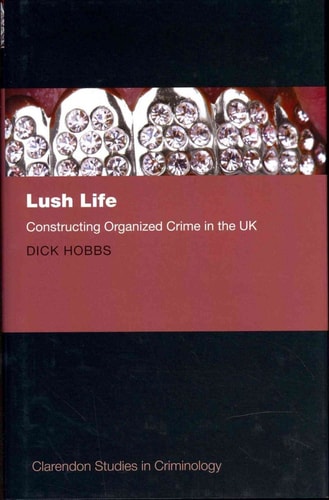
Lush Life: Constructing Organized Crime in the UK
0
0
As an Amazon Associate and affiliate partner, Menrva Books earns from qualifying purchases. Learn more
Author Description
Lush Life: Constructing Organized Crime in the UK opens 'the box marked do not open, too difficult to deal with', in the words of one Assistant Chief Constable, to explore the contested notion of British organized crime. The first book to trace the history and policing of British organized crime, it addresses how the interlocking processes of de-industrialisation, globalisation and neo-liberalism have normalised activity that was previously the exclusive domain of professional criminals.With both historical and sociological analyses, informed by the author's long term connection to an ethnographic site called 'Dogtown', a composite of several overlapping neighbourhoods in East London, this book critically addresses cliches such as criminal underworlds and the notion of the criminal firm. It considers the precursors to British organized crime, as well as the careers of famous crime families such as the Krays and the Richardsons, alongside the emergence of specialised law enforcement institutions to deal with this newly discovered threat. It also focuses on the various ways in which violence functions within organised crime, the role of rumour in formulating order within crime networks, the social construction of organised crime, the development of the cosmopolitan criminal and the all-inclusive nature of the contemporary criminal community of practice. Permeating throughout is a discussion of the flexible nature of the criminal market, the constructed nature of the notion of organised crime, and the normalisation of criminality.Underpinned by rich, context-specific examples, case studies, stories, and other qualitative evidence based on ethnographic research and interviews, Lush Life follows on from the author's work on normal crime (Doing the Business), and professional crime (Bad Business).
Menrva's Summary
THE THESIS
This book investigates the social construction and historical evolution of organized crime in the United Kingdom, challenging the conventional perception of criminal underworlds. Author Dick Hobbs, a prominent criminologist, utilizes his extensive ethnographic research in East London to argue that organized crime is not a static entity but a fluid phenomenon shaped by de-industrialization, globalization, and neo-liberal economic policies. By examining the transition from traditional professional crime to contemporary criminal networks, the text provides a critical framework for understanding how criminality has become normalized within modern British society.
THE SCOPE MAP
What You Will Find
- Historical analysis of British crime families including the Krays and the Richardsons.
- Ethnographic case studies from the East London site known as Dogtown.
- Examination of the role of violence, rumor, and social networks in criminal organization.
- Critical assessment of law enforcement institutions and their response to organized crime.
THE AUTHORITY PERSPECTIVE
Experts in the field of criminology recognize this work as a significant contribution to the sociological understanding of criminal markets and the limitations of traditional law enforcement narratives. Readers frequently note the academic density of the prose, which balances rigorous theoretical analysis with detailed, context-specific qualitative evidence.
Page Count:
344
Publication Date:
2013-03-01
Publisher:
Oxford University Press
ISBN-10:
0199668280
ISBN-13:
9780199668281
True Crime
History
Sociology
Social Science
Criminology
Community Tags
Other Editions(3)


Similar Books


Reader Comments
Share Your Thoughts
No comments yet. Be the first to share your thoughts!