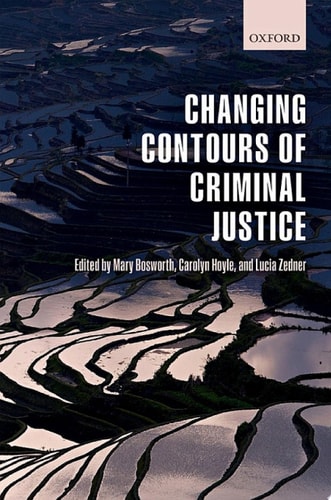
Changing Contours of Criminal Justice
0
0
As an Amazon Associate and affiliate partner, Menrva Books earns from qualifying purchases. Learn more
Author Description
Celebrating the 50th Anniversary of the Oxford Centre for Criminology, this edited collection of essays seeks to explore the changing contours of criminal justice over the past half century and to consider possible shifts over the next few decades. The question of how social science disciplines develop and change does not invite any easy answer, with the task made all the more difficult given the highly politicised nature of some subjects and the volatile, evolving status of its institutions and practices. A case in point is criminal justice: at once fairly parochial, much criminal justice scholarship is now global in its reach and subject areas that are now accepted as central to its study - victims, restorative justice, security, privatization, terrorism, citizenship and migration (to name just a few) - were topics unknown to the discipline half a century ago. Indeed, most criminologists would have once stoutly denied that they had anything to do with it. Likewise, some central topics of past criminological attention, like probation, have largely receded from academic attention and some central criminal justice institutions, like Borstal and corporal punishment, have, at least in Europe, been abolished. Although the rapidity and radical nature of this change make it quite impossible to predict what criminal justice will look like in fifty years' time, reflection on such developments may assist in understanding how it arrived at its current form and hint at what the future holds. The contributors to this volume have been invited to reflect on the impact Oxford criminology has had on the discipline, providing a unique and critical discussion about the current state of criminal justice around the world and the origins and future implications of contemporary practice. All are leading internationally-renowned criminologists whose work has defined and often re-defined our understanding of criminal justice policy and literature.
Menrva's Summary
THE THESIS
This volume investigates how the field of criminal justice has evolved over the past fifty years and identifies the factors that will likely shape its trajectory in the coming decades. The editors, Mary Bosworth, Carolyn Hoyle, and Lucia Zedner, curate a collection of essays from internationally recognized scholars to analyze the shifting institutional and academic landscape of criminology. By examining the historical development of the discipline alongside contemporary global challenges, the authors provide a framework for understanding the current state of criminal justice policy and practice.
THE SCOPE MAP
What You Will Find
- Historical analysis of the Oxford Centre for Criminology's influence on the field.
- Examinations of emerging topics including restorative justice, security, privatization, terrorism, and migration.
- Critical assessments of the decline of traditional institutions like probation and the abolition of practices such as corporal punishment.
Scope Limits
- The text does not provide a definitive prediction of the state of criminal justice fifty years into the future.
- The analysis focuses heavily on the impact of the Oxford tradition rather than providing a comprehensive global history of all criminological schools of thought.
THE AUTHORITY PERSPECTIVE
Experts identify this collection as a significant retrospective on the development of modern criminology and its institutional shifts. Readers frequently note the academic density of the prose, which serves as a foundational resource for scholars and students interested in the evolution of criminal justice policy.
Page Count:
323
Publication Date:
2016-01-01
Publisher:
OUP Oxford
ISBN-10:
0191092835
ISBN-13:
9780191092831
History
African American
Academic
Sociology
Social History
Criminology
Law
Social Science
South AL AR FL GA KY LA MS NC SC TN VA WV
Community Tags
Other Editions(2)

Similar Books








Reader Comments
Share Your Thoughts
No comments yet. Be the first to share your thoughts!