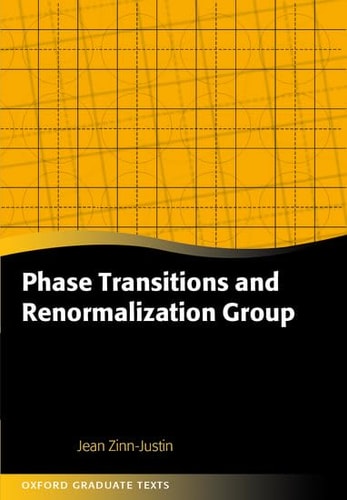
Phase Transitions and Renormalization Group
0
0
As an Amazon Associate and affiliate partner, Menrva Books earns from qualifying purchases. Learn more
Author Description
This work tries to provide an elementary introduction to the notions of continuum limit and universality in statistical systems with a large number of degrees of freedom. The existence of a continuum limit requires the appearance of correlations at large distance, a situation that is encountered in second order phase transitions, near the critical temperature. In this context, we will emphasize the role of gaussian distributions and their relations with the mean field approximation and Landau's theory of critical phenomena. We will show that quasi-gaussian or mean-field approximations cannot describe correctly phase transitions in three space dimensions. We will assign this difficulty to the coupling of very different physical length scales, even though the systems we will consider have only local, that is, short range interactions. To analyze the unusual situation, a new concept is required: the renormalization group, whose fixed points allow understanding the universality of physical properties at large distance, beyond mean-field theory. In the continuum limit, critical phenomena can be described by quantum field theories. In this framework, the renormalization group is directly related to the renormalization process, that is, the necessity to cancel the infinities that arise in straightforward formulations of the theory. We thus discuss the renormalization group in the context of various relevant field theories. This leads to proofs of universality and to efficient tools for calculating universal quantities in a perturbative framework. Finally, we construct a general functional renormalization group, which can be used when perturbative methods are inadequate.
Menrva's Summary
THE THESIS
This text investigates the fundamental mechanisms of phase transitions and the necessity of the renormalization group to explain universality in systems with large numbers of degrees of freedom. Jean Zinn-Justin, a prominent physicist, utilizes his extensive background in quantum field theory to bridge the gap between statistical mechanics and critical phenomena. The book argues that traditional mean-field approximations fail in three dimensions, necessitating a more robust framework that accounts for coupled length scales and the renormalization process.
THE SCOPE MAP
What You Will Find
- Analysis of continuum limits and universality in statistical systems.
- Detailed examination of Gaussian distributions and Landau's theory of critical phenomena.
- Theoretical framework connecting critical phenomena to quantum field theories.
- Construction of a functional renormalization group for non-perturbative scenarios.
THE AUTHORITY PERSPECTIVE
Experts recognize this work as a rigorous and foundational text for graduate-level study in theoretical physics. Readers frequently note the high level of mathematical density and the technical precision required to fully grasp the author's arguments.
Page Count:
464
Publication Date:
2013-02-07
Publisher:
Oxford University Press
ISBN-10:
0199665168
ISBN-13:
9780199665167
Science
Statistical mechanics
Physics
Academic
Statistical physics
Mass Physics
Community Tags
Other Editions(3)


Similar Books












Reader Comments
Share Your Thoughts
No comments yet. Be the first to share your thoughts!