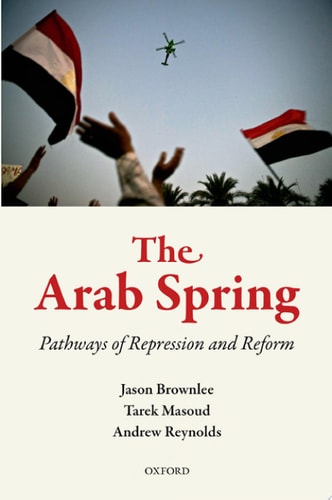
The Arab Spring: Pathways of Repression and Reform
0
0
As an Amazon Associate and affiliate partner, Menrva Books earns from qualifying purchases. Learn more
Author Description
Several years after the Arab Spring began, democracy remains elusive in the Middle East. The Arab Spring that resides in the popular imagination is one in which a wave of mass mobilization swept the broader Middle East, toppled dictators, and cleared the way for democracy. The reality is that few Arab countries have experienced anything of the sort. While Tunisia made progress towards some type of constitutionally entrenched participatory rule, the other countries that overthrew their rulers-Egypt, Yemen, and Libya-remain mired in authoritarianism and instability. Elsewhere in the Arab world uprisings were suppressed, subsided or never materialized.The Arab Spring's modest harvest cries out for explanation. Why did regime change take place in only four Arab countries and why has democratic change proved so elusive in the countries that made attempts? This book attempts to answer those questions. First, by accounting for the full range of variance: from the absence or failure of uprisings in such places as Algeria and Saudi Arabia at one end to Tunisia's rocky but hopeful transition at the other. Second, by examining the deep historical and structure variables that determined the balance of power between incumbents and opposition.Brownlee, Masoud, and Reynolds find that the success of domestic uprisings depended on the absence of a hereditary executive and a dearth of oil rents. Structural factors also cast a shadow over the transition process. Even when opposition forces toppled dictators, prior levels of socioeconomic development and state strength shaped whether nascent democracy, resurgent authoritarianism, or unbridled civil war would follow.
Menrva's Summary
THE THESIS
This book investigates why the Arab Spring resulted in democratic transition in only a few instances while leading to persistent authoritarianism or instability in others. The authors, Andrew Reynolds, Jason Brownlee, and Tarek Masoud, utilize a comparative political framework to analyze the structural and historical variables that influenced the outcomes of uprisings across the Middle East. By examining the interplay between state strength, oil rents, and hereditary succession, they provide a systematic explanation for the varying degrees of success in regional reform efforts.
THE SCOPE MAP
What You Will Find
- Comparative analysis of political outcomes across diverse Arab nations including Tunisia, Egypt, Libya, and Yemen.
- Examination of structural variables such as socioeconomic development and the presence of hereditary executive power.
- Assessment of the impact of oil rents on the stability of incumbent regimes.
- Evaluation of the transition processes from mass mobilization to either democratic consolidation or renewed authoritarianism.
THE AUTHORITY PERSPECTIVE
Experts recognize this work as a rigorous empirical analysis that moves beyond popular narratives to examine the structural constraints of regional politics. Scholars frequently cite the text for its clear methodology and its ability to synthesize complex historical data into a coherent political science framework.
Page Count:
352
Publication Date:
2015-04-26
Publisher:
Oxford University Press
ISBN-10:
0199660069
ISBN-13:
9780199660063
History
International relations
Democracy
Comparative Politics
Middle East
Community Tags
Similar Books