Democracy in Iran: History and the Quest for Liberty
Author Description
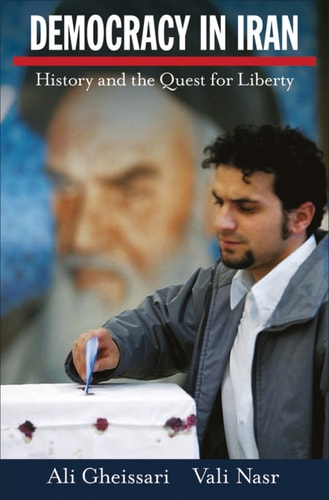
Today Iran is once again in the headlines. Reputed to be developing nuclear weapons, the future of Iraq's next-door neighbor is a matter of grave concern both for the stability of the region and for the safety of the global community. President George W. Bush labeled it part of the "Axis of Evil," and rails against the country's authoritarian leadership. Yet as Bush trumpets the spread of democracy throughout the Middle East, few note that Iran has one of the longest-running experiences with democracy in the region.In this book, Ali Gheissari and Vali Nasr look at the political history of Iran in the modern era, and offer an in-depth analysis of the prospects for democracy to flourish there. After having produced the only successful Islamist challenge to the state, a revolution, and an Islamic Republic, Iran is now poised to produce a genuine and indigenous democratic movement in the Muslim world. Democracy in Iran is neither a sudden development nor a western import, Gheissari and Nasr argue. The concept of democracy in Iran today may appear to be a reaction to authoritarianism, but it is an old idea with a complex history, one that is tightly interwoven with the main forces that have shaped Iranian society and politics, institutions, identities, and interests. Indeed, the demand for democracy first surfaced in Iran a century ago at the end of the Qajar period, and helped produce Iran's surprisingly liberal first constitution in 1906. Gheissari and Nasr seek to understand why democracy failed to grow roots and lost ground to an autocratic Iranian state. Why was democracy absent from the ideological debates of the 1960s and 1970s? Most important, why has it now become a powerful social, political, and intellectual force? How have modernization, social change, economic growth, and the experience of the revolution converged to make this possible?
Menrva's Summary
THE THESIS
This book investigates the historical trajectory of democratic movements in Iran to determine why the concept has persisted as a powerful social and political force despite repeated failures to take root. Authors Ali Gheissari and Vali Nasr utilize a comprehensive historical framework to analyze the evolution of Iranian political institutions, identities, and interests from the Qajar period to the modern era. They argue that the current demand for democracy is not a Western import but an indigenous development shaped by a century of social change, economic growth, and the unique experience of the Islamic Revolution.
THE SCOPE MAP
What You Will Find
- Historical analysis of the 1906 constitutional movement and its subsequent decline.
- Examination of the ideological shifts in Iranian politics during the 1960s and 1970s.
- Assessment of how modernization and economic development influence contemporary political aspirations.
- Evaluation of the interplay between authoritarian state structures and grassroots democratic demands.
THE AUTHORITY PERSPECTIVE
Experts recognize this work as a foundational text for understanding the historical depth of Iranian political thought. Readers frequently note the academic density of the prose, which provides a rigorous counter-narrative to common Western perceptions of Iranian political history.
Page Count:
232
Publication Date:
2006-01-01
Publisher:
Oxford University Press
ISBN-10:
0199885060
ISBN-13:
9780199885060
History
Iran
Middle Eastern
International relations
Comparative Politics
Democracy
Middle East
Community Tags
Similar Books