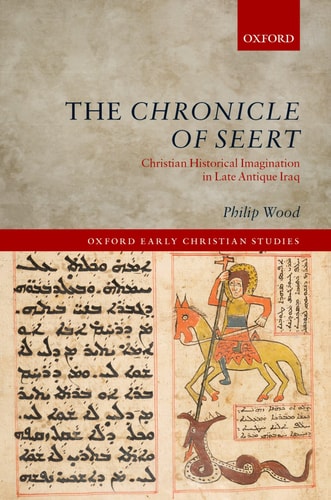
The Chronicle of Seert: Christian Historical Imagination in Late Antique Iraq
0
0
As an Amazon Associate and affiliate partner, Menrva Books earns from qualifying purchases. Learn more
Author Description
This is an open access title available under the terms of a CC BY-NC-ND 3.0 International licence. It is free to read at Oxford Scholarship Online and offered as a free PDF download from OUP and selected open access locations.This monograph uses a medieval Arabic chronicle, The Chronicle of Seert, as a window into the Christian history of Iraq. The Chronicle describes events that are unknown from other sources, but it is most useful for what it tells us about the changes agendas of those who wrote history and their audiences in the period c.400-800.By splitting the Chronicle into its constituent layers, Philip Wood presents a rich cultural history of Iraq. He examines the Christians' self-presentation as a church of the martyrs and the uncomfortable reality of close engagement with the Sasanian state. The history of the past was used as a source of solidarity in the present, to draw together disparate Christian communities. But it also represented a means of criticising figures in the present, whether these be secular rulers or over-mighty bishops and abbots.The Chronicle gives us an insight into the development of an international awareness within the church in Iraq. Christians increasingly raised their horizons to the Roman Empire in the West, which offered a model of Christian statehood, while also being the source of resented theological innovation or heresy. It also shows us the competing strands of patronage within the church: between laymen and clergy; church and state; centre and periphery. Building on earlier scholarship rooted in the contemporary Syriac sources, Wood complements that picture with the testimony of this later witness.
Menrva's Summary
THE THESIS
This study investigates how the medieval Arabic text, The Chronicle of Seert, functioned as a tool for shaping Christian identity and political discourse in late antique Iraq. Philip Wood, a scholar of late antique history, utilizes this specific chronicle to analyze the shifting agendas of ecclesiastical writers between 400 and 800 CE. By deconstructing the text into its historical layers, the author argues that the chronicle served as both a mechanism for fostering communal solidarity and a platform for critiquing contemporary secular and religious leadership.
THE SCOPE MAP
What You Will Find
- Analysis of the social and political history of Iraq from the 5th to the 9th centuries.
- Examination of the relationship between the Church of the East and the Sasanian state.
- Investigation into the influence of Roman imperial models on Iraqi Christian identity.
- Exploration of internal church power dynamics, including patronage and clerical authority.
THE AUTHORITY PERSPECTIVE
Experts recognize this work as a significant contribution to the study of Syriac and Arabic Christian historiography. Readers frequently note the academic density of the prose, which provides a rigorous framework for understanding the complex cultural landscape of the period.
Page Count:
320
Publication Date:
2013-09-18
Publisher:
Oxford University Press
ISBN-10:
0199670676
ISBN-13:
9780199670673
History
Christianity
Academic
Middle East
Social Life
Community Tags
Similar Books