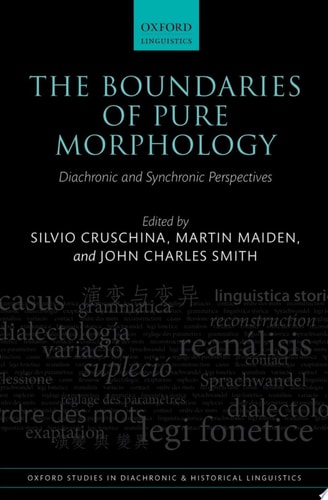
The Boundaries of Pure Morphology: Diachronic and Synchronic Perspectives
0
0
As an Amazon Associate and affiliate partner, Menrva Books earns from qualifying purchases. Learn more
Author Description
This book brings together leading international scholars to consider whether in some languages there are phenomena which are unique to morphology, determined neither by phonology or syntax. Central to these phenomena is the notion of the 'morphome', conceived by Mark Aronoff in 1994 as a function, itself lacking form and meaning but which serves systematically to relate them. The classic examples of morphomes are determined neither phonologically or morphosyntactically, and appear to be an autonomous property of the synchronic organization of morphological paradigms. The nature of the morphome is a problematic and much debated issue at the centre of current research in morphology, partly because it is defined negatively as what remains after all attempts to assign putatively morphomic phenomena to phonological or morphosyntactic conditioning have been exhausted. However, morphomic phenomena generally originate in some kind of morphosyntactic or phonological conditioning which has been lost while their effects have endured. Quite often, vestiges of the original conditioning environment persist, and the boundary between the morphomic and extramorphological conditioning may become problematic. In a series of pioneering explorations of the diachrony of morphomes The Boundaries of Pure Morphology throws important new light on the nature of the morphome and the boundary - seen from both diachronic and synchronic perspectives - between what is and is not genuinely autonomous in morphology. Its findings will be of central interest to morphologists of all theoretical stripes as well as to all those concerned to understand the precise nature of linguistic diachrony.
Menrva's Summary
THE THESIS
This volume investigates whether specific linguistic phenomena exist that are unique to morphology, independent of phonological or syntactic influence. The editors, John Charles Smith, Martin Maiden, and Silvio Cruschina, assemble a collection of international scholars to examine the concept of the 'morphome' as defined by Mark Aronoff. The text argues that while morphomes are often defined by the absence of external conditioning, they frequently emerge from historical processes where original phonological or morphosyntactic triggers have been lost, leaving behind autonomous structural patterns.
THE SCOPE MAP
What You Will Find
- Theoretical analysis of the 'morphome' as a function relating form and meaning.
- Diachronic studies tracing the historical evolution of morphological paradigms.
- Synchronic examinations of autonomous morphological organization.
- Comparative research on the boundaries between morphomic and extramorphological conditioning.
THE AUTHORITY PERSPECTIVE
Experts recognize this collection as a significant contribution to the ongoing debate regarding the autonomy of morphological systems. Readers frequently note the high level of academic density, making it a specialized resource for researchers and advanced students of historical linguistics.
Page Count:
352
Publication Date:
2013-10-08
Publisher:
Oxford University Press
ISBN-10:
0199678863
ISBN-13:
9780199678860
Reference
Academic
Linguistics
Historical linguistics
Morphology
Community Tags
Similar Books