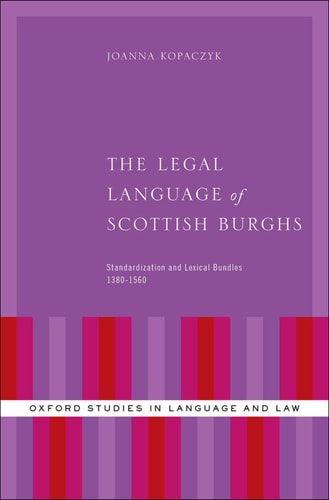
The Legal Language of Scottish Burghs: Standardization and Lexical Bundles (1380-1560)
0
0
As an Amazon Associate and affiliate partner, Menrva Books earns from qualifying purchases. Learn more
Author Description
This book offers an innovative, corpus-driven approach to historical legal discourse. It is the first monograph to examine textual standardization patterns in legal and administrative texts on the basis of lexical bundles, drawing on a comprehensive corpus of medieval and early modern legal texts. The book's focus is on legal language in Scotland, where law--with its own nomenclature and its own repertoire of discourse features--was shaped and marked by the concomitant standardizing of the vernacular language, Scots, a sister language to the English of the day. Joanna Kopaczyk's study is based on a unique combination of two methodological frameworks: a rigorous corpus-driven data analysis and a pragmaphilological, context-sensitive qualitative interpretation of the findings. Providing the reader with a rich socio-historical background of legal discourse in medieval and early modern Scottish burghs, Kopaczyk traces the links between orality, community, and law, which are reflected in discourse features and linguistic standardization of legal and administrative texts. In this context, the book also revisits important ingredients of legal language, such as binomials or performatives. Kopaczyk's study is grounded in the functional approach to language and pays particular attention to referential, interpersonal, and textual functions of lexical bundles in the texts. It also establishes a connection between the structure and function of the recurrent patterns, and paves the way for the employment of new methodologies in historical discourse analysis.
Menrva's Summary
THE THESIS
How did the standardization of the Scots vernacular influence the development of legal and administrative discourse in Scottish burghs between 1380 and 1560? Joanna Kopaczyk, a specialist in historical linguistics, utilizes a corpus-driven methodology to analyze lexical bundles within medieval and early modern legal documents. By integrating quantitative data analysis with pragmaphilological interpretation, the author argues that legal language evolved through specific functional patterns that reflect the intersection of community, orality, and administrative authority.
THE SCOPE MAP
What You Will Find
- A comprehensive corpus of medieval and early modern Scottish legal and administrative texts.
- Methodological application of lexical bundles to historical discourse analysis.
- Analysis of linguistic features including binomials, performatives, and functional discourse markers.
- Socio-historical context regarding the development of the Scots language.
Scope Limits
- The study is restricted to the timeframe of 1380 to 1560.
- The analysis focuses specifically on Scottish burgh legal records rather than broader national or international legal systems.
THE AUTHORITY PERSPECTIVE
Scholars in historical linguistics and legal history identify this work as a significant contribution to the study of corpus-driven methodologies in diachronic discourse analysis. Readers frequently note the academic density of the prose, which serves as a rigorous resource for researchers examining the intersection of vernacular standardization and institutional language.
Page Count:
356
Publication Date:
2013-01-01
Publisher:
Oxford University Press
ISBN-10:
0190243317
ISBN-13:
9780190243319
Scots Language
English & College Success
Politics & Government
Law
English
Linguistics
Law scotland
Professional Career & Trade
Legal History
Historical linguistics
Academic
Scottish History
Community Tags
Similar Books