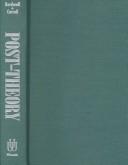
Post-Theory
0
0
As an Amazon Associate and affiliate partner, Menrva Books earns from qualifying purchases. Learn more
Author Description
Since the 1970s, the academic study of film has been dominated by Structuralist Marxism, varieties of cultural theory, and the psychoanalytic ideas of Freud and Lacan. With Post-Theory, David Bordwell and Noel Carroll have opened the floor to other voices challenging the prevailing practices of film scholarship. Addressing topics as diverse as film scores, national film industries, and audience response. Post-Theory offers fresh directions for understanding film. Bordwell and Carroll pose a simple question. Why not employ many theories tailored to specific goals, rather than searching for a unified theory that will explain all sorts of films, their production, and their reception? The scholars writing here use historical, philosophical, psychological, and feminist methods to tackle such basic issues as: What goes on when viewers perceive a film? How do filmmakers exploit conventions? How do movies create illusions? How does a film arouse emotion? Bordwell and Carroll have given space not only to distinguished film scholars but to non-film specialists as well, ensuring a wide variety of opinions and ideas on virtually every topic on the current agenda of film studies. Full of stimulating essays published here for the first time, Post-Theory promises to redefine the study of cinema.
Menrva's Summary
THE THESIS
The prevailing dominance of Structuralist Marxism, cultural theory, and psychoanalytic ideas in film scholarship is challenged by the diverse methodologies presented in Post-Theory. This collection questions the pursuit of a single, unified theory for understanding film, advocating instead for the use of multiple, specific theories tailored to particular goals. The essays explore a wide range of topics, including film scores, national film industries, audience response, viewer perception, the exploitation of conventions by filmmakers, the creation of illusions, and the arousal of emotion. By incorporating perspectives from distinguished film scholars and non-film specialists, the book offers a broad spectrum of opinions and ideas aimed at redefining the study of cinema.
THE SCOPE MAP
- What goes on when viewers perceive a film?
- How do filmmakers exploit conventions?
- How do movies create illusions?
- How does a film arouse emotion?
- Exploration of film scores
- Analysis of national film industries
- Examination of audience response
- Application of historical, philosophical, psychological, and feminist methods
THE AUTHORITY PERSPECTIVE
The collection Post-Theory, edited by David Bordwell and Noel Carroll, is presented as a significant intervention in film studies, aiming to broaden the theoretical landscape beyond the dominant paradigms of the late 20th century. The essays within are designed to offer fresh directions for understanding film by employing a variety of theoretical approaches, including historical, philosophical, psychological, and feminist methods. By bringing together established film scholars and non-specialists, the book promises a wide array of opinions and ideas on current film studies topics. The collection is positioned as a work that will redefine the study of cinema through its diverse and stimulating contributions.
Page Count:
564
Publication Date:
1996-01-01
ISBN-10:
0299149404
Philosophy
Non-Fiction
Psychology
Film Studies
Cultural Theory
Feminist Theory
Community Tags
Similar Books