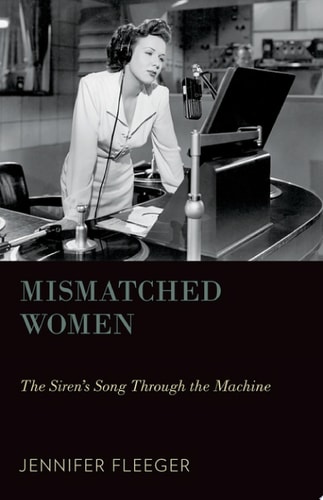
Mismatched Women: The Siren's Song Through the Machine
0
0
As an Amazon Associate and affiliate partner, Menrva Books earns from qualifying purchases. Learn more
Author Description
In Mismatched Women, author Jennifer Fleeger introduces readers to a lineage of women whose voices do not "match" their bodies by conventional expectations, from George du Maurier's literary Trilby to Metropolitan Opera singer Marion Talley, from Snow White and Sleeping Beauty to Kate Smith and Deanna Durbin. The book tells a new story about female representation by theorizing a figure regularly dismissed as an aberration. The mismatched woman is a stumbling block for both sound and feminist theory, argues Fleeger, because she has been synchronized yet seems to have been put together incorrectly, as if her body could not possibly house the voice that the camera insists belongs to her. Fleeger broadens the traditionally cinematic context of feminist film theory to account for literary, animated, televisual, and virtual influences. This approach bridges gaps between disciplinary frameworks, showing that studies of literature, film, media, opera, and popular music pose common questions about authenticity, vocal and visual realism, circulation, and reproduction. The book analyzes the importance of the mismatched female voice in historical debates over the emergence of new media and unravels the complexity of female representation in moments of technological change.
Menrva's Summary
THE THESIS
This book investigates the cultural and theoretical implications of the 'mismatched woman,' a figure whose voice is perceived as incongruous with her physical body within media and literature. Jennifer Fleeger, a scholar in media and music studies, examines this phenomenon across a wide range of historical and technological contexts. She argues that the mismatched female voice serves as a critical site for understanding anxieties regarding authenticity, vocal reproduction, and the evolution of media technologies from literature to virtual platforms.
THE SCOPE MAP
What You Will Find
- Analysis of female representation across literature, animation, opera, and film.
- Theoretical framework for evaluating vocal and visual realism in media.
- Historical examination of technological shifts and their impact on gendered performance.
- Case studies ranging from literary figures like Trilby to performers such as Marion Talley and Kate Smith.
THE AUTHORITY PERSPECTIVE
Scholars and critics recognize this work as a significant contribution to the intersection of sound studies and feminist film theory. The text is noted for its interdisciplinary approach, effectively bridging gaps between media history and cultural criticism for academic audiences.
Page Count:
264
Publication Date:
2014-01-01
Publisher:
Oxford University Press
ISBN-10:
0199936900
ISBN-13:
9780199936908
Music History
Singers
Gender Studies
Popular music
Film Studies
Humanities
Media Studies
Feminist Theory
Musicology
Woman Studies