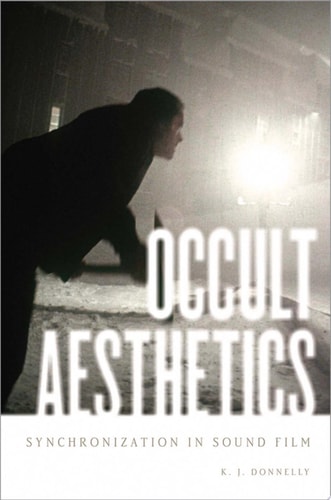
Occult Aesthetics: Synchronization in Sound Film
0
0
As an Amazon Associate and affiliate partner, Menrva Books earns from qualifying purchases. Learn more
Author Description
In this groundbreaking book, acclaimed film music author Kevin Donnelly offers the first sustained theorization of synchronization in sound film. Donnelly addresses the manner in which the lock of the audio and the visual exerts a perceptible synergy, an aesthetic he dubs occult: a secret and esoteric effect that can dissipate in the face of an awareness of its existence. Drawing upon theories of sound from Sergei Eisenstein to Pierre Schaeffer to Michel Chion, the book investigates points of synchronization as something like repose, providing moments of comfort in a potentially threatening environment that can be fraught with sound and image stimuli. Correspondingly, lack of synchrony between sound and images is characterized as potentially disturbing for the viewer, a discomfort that signals moments of danger. From this perspective, the interplay between the two becomes the central dynamic of audio-visual culture more generally, which, as Donnelly argues, provides a starting point for a new understanding of audio/visual interactions. This fresh approach to the topic is discussed in theoretical and historical terms as well as elaborated through analysis of and reference to a broad selection of films and their soundtracks including, among others, Singin' in the Rain, Saw, Shanghai Express, and Assault on Precinct 13.
Menrva's Summary
THE THESIS
How does the synchronization of sound and image in cinema function as an esoteric, occult aesthetic that shapes viewer perception and psychological comfort? K. J. Donnelly, a recognized scholar in film music, utilizes a framework derived from film theorists such as Sergei Eisenstein, Pierre Schaeffer, and Michel Chion to examine the mechanics of audio-visual alignment. He argues that synchronization acts as a stabilizing force, while asynchronous elements serve as indicators of danger or narrative instability within the cinematic experience.
THE SCOPE MAP
What You Will Find
- Theoretical analysis of audio-visual synchronization and its psychological impact on the audience.
- Historical examination of sound design evolution from early cinema to contemporary horror and musical genres.
- Comparative case studies of diverse films including Singin' in the Rain, Saw, Shanghai Express, and Assault on Precinct 13.
- A conceptual framework defining the 'occult' nature of sound-image synergy as a secret, esoteric effect.
THE AUTHORITY PERSPECTIVE
Scholars and film theorists identify this work as a significant contribution to the study of sound in cinema, noting its rigorous application of established media theory. Readers frequently highlight the text's ability to bridge the gap between technical sound design and broader cultural analysis.
Page Count:
274
Publication Date:
2013-01-01
Publisher:
Oxford University Press
ISBN-10:
0199773602
ISBN-13:
9780199773602
Media Studies
Film Studies
Music Technology
Music theory
Cultural Theory
Film History
Humanities
Community Tags
Similar Books