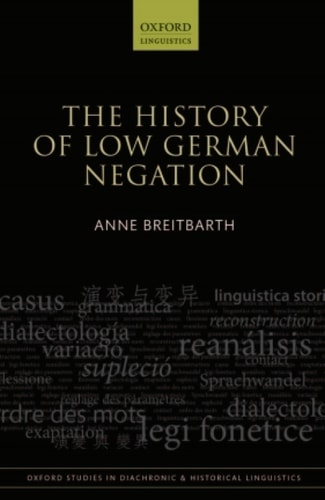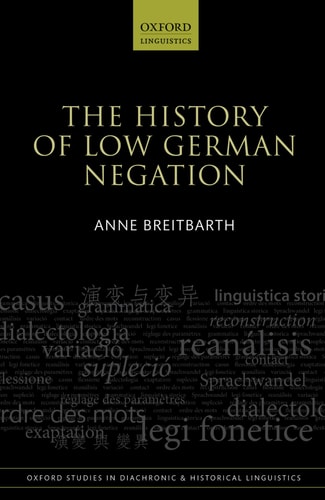
The History of Low German Negation
0
0
As an Amazon Associate and affiliate partner, Menrva Books earns from qualifying purchases. Learn more
Author Description
This book examines the diachronic development of negation in Low German, from Old Saxon up to the point at which Middle Low German is replaced by High German as the written language. It investigates both the development of standard negation, or Jespersen's Cycle, and the changing interaction between the expression of negation and indefinites in its scope, giving rise to negative concord along the way. Anne Breitbarth shows that developments in Low German form a missing link between those in High German, English, and Dutch, which have been much more widely researched. These changes are analysed using a generative account of syntactic change combined with minimalist assumptions concerning the syntax of negation and negative concord.The book provides the first substantial, diachronic analysis of the development of the expression of negation through the Old Saxon and Middle Low German periods, and will be of interest not only to students and researchers in the history of German, but also to all those working on the syntax of negation from a diachronic and synchronic perspective.
Menrva's Summary
THE THESIS
This book investigates the diachronic evolution of negation in Low German, specifically tracking the transition from Old Saxon through the Middle Low German period. Anne Breitbarth, a specialist in historical linguistics, utilizes a generative syntactic framework to analyze the structural shifts in negation patterns. By applying minimalist assumptions, she demonstrates how Low German serves as a critical link in understanding the broader development of negation across Germanic languages, including High German, English, and Dutch.
THE SCOPE MAP
What You Will Find
- A diachronic analysis of Jespersen's Cycle within the Low German language family.
- Examination of the interaction between negation and indefinites leading to negative concord.
- Application of generative syntactic theory to historical linguistic data.
- Comparative study linking Low German developments to High German, English, and Dutch.
THE AUTHORITY PERSPECTIVE
Reader & Expert Consensus: Experts recognize this work as a foundational study for filling a significant gap in the diachronic research of Germanic negation. Readers frequently note the academic density of the prose, which is tailored for researchers and students specializing in historical syntax.
Page Count:
216
Publication Date:
2014-11-25
Publisher:
Oxford University Press
ISBN-10:
0199687285
ISBN-13:
9780199687282
Linguistics
Syntax
Negation Logic
Germanic Languages
Academic
Historical linguistics