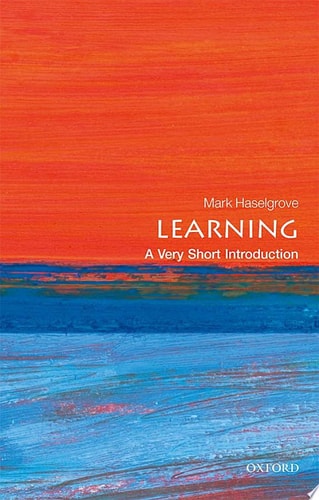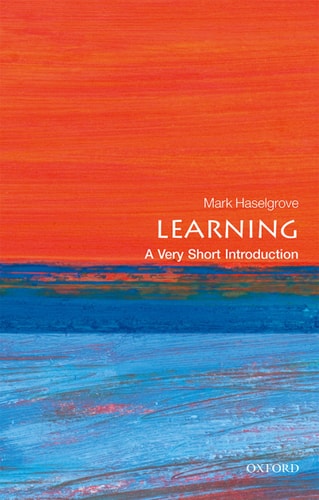
Learning: A Very Short Introduction
0
0
As an Amazon Associate and affiliate partner, Menrva Books earns from qualifying purchases. Learn more
Author Description
What is learning? How does it take place? What happens when it goes wrong?The topic of learning has been central to the development of the science of psychology since its inception. Without learning there can be no memory, no language and no intelligence. Indeed it is rather difficult to imagine a part of psychology, or neuroscience, that learning does not touch upon. In this Very Short Introduction, Mark Haselgrove describes learning from the perspective of associative theories of classical and instrumental conditioning, and considers why these are the dominant, and best described analyses of learning in contemporary psychology. Tracing the origins of these theories, he discusses the techniques used to study learning in both animals and humans, and considers the importance of learning for animal behavior and survival.ABOUT THE SERIES: The Very Short Introductions series from Oxford University Press contains hundreds of titles in almost every subject area. These pocket-sized books are the perfect way to get ahead in a new subject quickly. Our expert authors combine facts, analysis, perspective, new ideas, and enthusiasm to make interesting and challenging topics highly readable.
Menrva's Summary
THE THESIS
This book investigates the fundamental mechanisms of learning and its central role in the development of psychology and neuroscience. Mark Haselgrove, an expert in the field, utilizes associative theories of classical and instrumental conditioning to explain how learning functions in both humans and animals. He provides a concise framework for understanding how these processes underpin memory, language, and intelligence, while examining the historical development of these psychological theories.
THE SCOPE MAP
What You Will Find
- Analysis of associative theories including classical and instrumental conditioning
- Historical origins of learning theories in psychological science
- Methodologies and techniques used to study learning in animal and human subjects
- Discussion on the biological importance of learning for behavior and survival
THE AUTHORITY PERSPECTIVE
This text is recognized as a concise, accessible entry point for students and general readers interested in the psychological foundations of learning. Experts frequently note that the book successfully distills complex behavioral theories into a readable format without sacrificing scientific accuracy.
Page Count:
144
Publication Date:
2016-09-01
Publisher:
Oxford University Press
ISBN-10:
0199688362
ISBN-13:
9780199688364
Psychology
Non-Fiction
Learning Psychology of
Neuroscience
Education