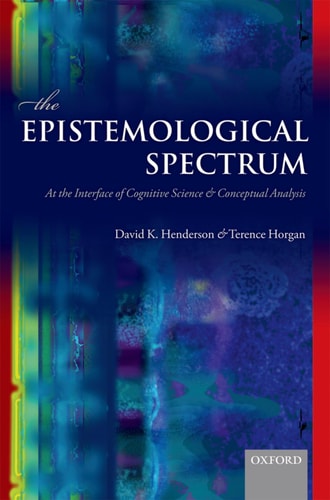
Epistemological Spectrum
0
0
As an Amazon Associate and affiliate partner, Menrva Books earns from qualifying purchases. Learn more
Author Description
David Henderson and Terence Horgan set out a broad new approach to epistemology, which they see as a mixed discipline, having both a priori and empirical elements. They defend the roles of a priori reflection and conceptual analysis in philosophy, but their revisionary account of these philosophical methods allows them a subtle but essential empirical dimension. They espouse a dual-perspective position which they call iceberg epistemology, respecting the important differences between epistemic processes that are consciously accessible and those that are not. Reflecting on epistemic justification, they introduce the notion of transglobal reliability as the mark of the cognitive processes that are suitable for humans. Which cognitive processes these are depends on contingent facts about human cognitive capacities, and these cannot be known a priori.
Menrva's Summary
THE THESIS
This book investigates the nature of epistemic justification by proposing a mixed methodological framework that integrates both a priori reflection and empirical inquiry. The authors, David K. Henderson and Terence Horgan, argue against the strict separation of philosophical and empirical disciplines. They introduce the concept of 'iceberg epistemology' to account for the interplay between conscious and unconscious cognitive processes, ultimately grounding human knowledge in the notion of transglobal reliability.
THE SCOPE MAP
What You Will Find
- A dual-perspective framework for understanding epistemic processes.
- An analysis of the role of conceptual analysis in modern philosophy.
- A detailed exploration of transglobal reliability as a criterion for cognitive justification.
- An examination of how contingent human cognitive capacities influence philosophical inquiry.
THE AUTHORITY PERSPECTIVE
Experts recognize this text as a significant contribution to contemporary epistemology, particularly for its attempt to bridge the divide between analytic philosophy and empirical cognitive science. Readers frequently note the academic density of the prose, which is intended for advanced students and professional philosophers engaged in meta-epistemological debates.
Page Count:
306
Publication Date:
2013-01-01
Publisher:
Oxford University Press
ISBN-10:
0199684758
ISBN-13:
9780199684755
Philosophy
Epistemology
Knowledge Theory
Academic
Community Tags
Similar Books