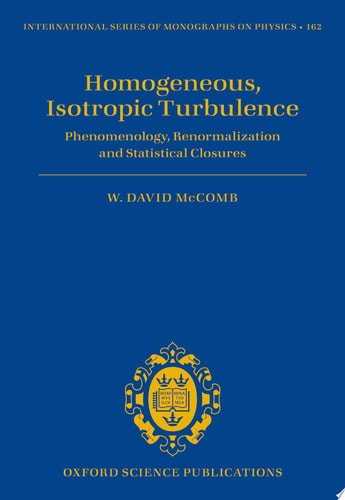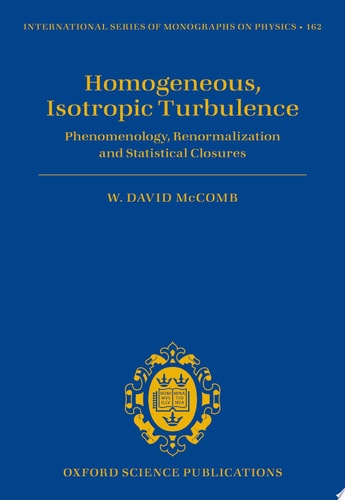
Homogeneous, Isotropic Turbulence: Phenomenology, Renormalization and Statistical Closures
0
0
As an Amazon Associate and affiliate partner, Menrva Books earns from qualifying purchases. Learn more
Author Description
Fluid turbulence is often referred to as `the unsolved problem of classical physics'. Yet, paradoxically, its mathematical description resembles quantum field theory. The present book addresses the idealised problem posed by homogeneous, isotropic turbulence, in order to concentrate on the fundamental aspects of the general problem. It is written from the perspective of a theoretical physicist, but is designed to be accessible to all researchers in turbulence, both theoretical and experimental, and from all disciplines. The book is in three parts, and begins with a very simple overview of the basic statistical closure problem, along with a summary of current theoretical approaches. This is followed by a precise formulation of the statistical problem, along with a complete set of mathematical tools (as needed in the rest of the book), and a summary of the generally accepted phenomenology of the subject. Part 2 deals with current issues in phenomenology, including the role of Galilean invariance, the physics of energy transfer, and the fundamental problems inherent in numerical simulation. Part 3 deals with renormalization methods, with an emphasis on the taxonomy of the subject, rather than on lengthy mathematical derivations. The book concludes with some discussion of current lines of research and is supplemented by three appendices containing detailed mathematical treatments of the effect of isotropy on correlations, the properties of Gaussian distributions, and the evaluation of coefficients in statistical theories.
Menrva's Summary
THE THESIS
This book investigates the fundamental mathematical and physical challenges of homogeneous, isotropic turbulence by framing it through the lens of theoretical physics. W. David McComb, an expert in the field, utilizes the structural similarities between fluid turbulence and quantum field theory to provide a rigorous framework for analysis. The text synthesizes current theoretical approaches, phenomenology, and statistical closure methods to address the complexities of energy transfer and numerical simulation in fluid systems.
THE SCOPE MAP
What You Will Find
- A comprehensive overview of the statistical closure problem in fluid dynamics.
- Detailed examination of renormalization methods and their taxonomy.
- Analysis of Galilean invariance and its role in turbulence phenomenology.
- Mathematical appendices covering correlation effects, Gaussian distribution properties, and coefficient evaluation.
THE AUTHORITY PERSPECTIVE
Experts recognize this work as a foundational text for researchers seeking to bridge the gap between experimental observations and theoretical physics. Readers frequently note the high level of technical rigor, making it a standard reference for those specializing in the mathematical modeling of turbulent flows.
Page Count:
480
Publication Date:
2014-05-01
Publisher:
Oxford University Press
ISBN-10:
0199689385
ISBN-13:
9780199689385
Science
Turbulence
Academic
Mathematics
Fluid dynamics
Physics