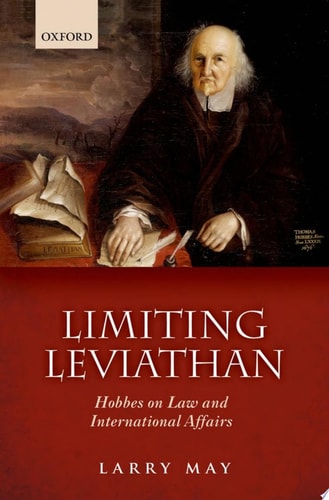
Limiting Leviathan: Hobbes on Law and International Affairs
0
0
As an Amazon Associate and affiliate partner, Menrva Books earns from qualifying purchases. Learn more
Author Description
Thomas Hobbes wrote extensively about law and was strongly influenced by developments and debates among lawyers of his day. And Hobbes is considered by many commentators to be one of the first legal positivists. Yet there is no book in English that focuses on Hobbes's legal philosophy. Indeed, Hobbes's own book length treatment of law, A Dialogue Between a Philosopher and a Student of the Common Laws of England, has also not received much commentary over the centuries. Larry May seeks to fill the gap in the literature by addressing Hobbes's legal philosophy directly, and comparing Leviathan to the Dialogue, as he offers a new interpretation of Hobbes's views about the connections among law, politics, and morality.May argues that Hobbes is much more amenable to moral, and even legal, limits on the law--indeed closer to Lon Fuller than to today's legal positivists--than he is often portrayed. He shows that Hobbes's views can provide a solid grounding for the rules of war and international relations generally, contrary to the near universal belief that Hobbes is the bete noir of international law. To support these views, May holds that Hobbes places greater weight on equity than on justice, and that understanding the role of equity is the key to his legal philosophy. Equity also is the moral concept that provides restrictions on what a sovereign can legitimately do, and if violated is the kind of limitation on sovereignty that could open the door for possible international institutions.
Menrva's Summary
THE THESIS
This work investigates whether Thomas Hobbes’s legal philosophy allows for moral and legal constraints on sovereign power, specifically within the context of international affairs. Larry May, a professor of philosophy and law, utilizes a comparative analysis of Hobbes’s major political treatises and his lesser-studied dialogue on English common law to challenge the prevailing view of Hobbes as a strict legal positivist. By re-evaluating the role of equity in Hobbesian thought, May constructs an argument that Hobbes provides a viable framework for international law and the regulation of conflict.
THE SCOPE MAP
What You Will Find
- A comparative analysis of Leviathan and A Dialogue Between a Philosopher and a Student of the Common Laws of England.
- An examination of the concept of equity as a foundational moral constraint on sovereign authority.
- A critique of the traditional interpretation of Hobbes as a proponent of absolute, unchecked state power.
- A theoretical application of Hobbesian principles to modern international relations and the rules of war.
THE AUTHORITY PERSPECTIVE
Scholars and legal historians recognize this text as a significant intervention in Hobbesian studies, particularly for its focus on the often-overlooked Dialogue. Readers frequently note the academic density of the prose, which is intended for those already familiar with political philosophy and legal theory.
Page Count:
272
Publication Date:
2013-11-15
Publisher:
Oxford University Press
ISBN-10:
0199682798
ISBN-13:
9780199682799
History
Philosophy
Legal Theory
Law Philosophy
International relations
Community Tags
Other Editions(2)
Similar Books