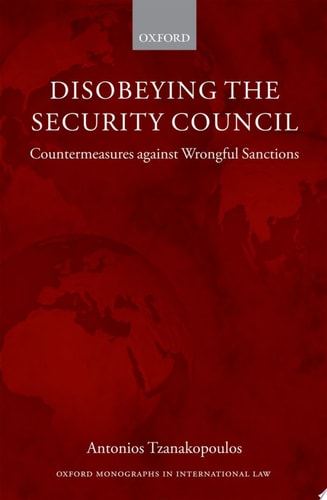
Disobeying the Security Council
0
0
As an Amazon Associate and affiliate partner, Menrva Books earns from qualifying purchases. Learn more
Author Description
This Book Examines How The United Nations Security Council, In Exercising Its Power To Impose Binding Non-forcible Measures ('sanctions') Under Article 41 Of The Un Charter, May Violate International Law. The Council May Overstep Limits On Its Power Imposed By The Un Charter Itself And By General International Law, Including Human Rights Guarentees. Such Acts May Engage The International Responsibility Of The United Nations, The Organization Of Which The Security Council Is An Organ. Disobeying The Security Council Discusses How And By Whom The Responsibility Of The Un For Unlawful Security Council Sanctions Can Be Determined; In Other Words, How The Un Can Be Held To Account For Security Council Excesses. The Central Thesis Of This Work Is That States Can Respond To Unlawful Sanctions Imposed By The Security Council, In A Decentralized Manner, By Disobeying The Security Council's Command. In International Law, This Disobedience Can Be Justified As Constituting A Countermeasure To The Security Council's Unlawful Act. Recent Practice Of States, Both In The Form Of Executive Acts And Court Decisions, Demonstrates An Increasing Tendency To Disobey Sanctions That Are Perceived As Unlawful. After Discussing Other Possible Qualifications Of Disobedience Under International Law, The Book Concludes That This Practice Can (and Should) Be Qualified As A Countermeasure.
Menrva's Summary
THE THESIS
This work investigates whether states may legally disobey United Nations Security Council sanctions when those measures violate international law or human rights guarantees. Antonios Tzanakopoulos, an expert in international law, examines the institutional accountability of the UN when its primary organ exceeds its Charter-mandated authority. The author argues that decentralized disobedience by states can be legally justified as a countermeasure against unlawful Security Council acts.
THE SCOPE MAP
What You Will Find
- Analysis of Article 41 of the UN Charter regarding non-forcible measures.
- Legal framework for state responsibility and the qualification of disobedience as a countermeasure.
- Review of recent executive acts and judicial decisions from various states.
Scope Limits
- The text focuses primarily on non-forcible sanctions rather than military interventions.
- It does not provide a comprehensive history of all UN sanctions, but rather a legal analysis of their limits.
THE AUTHORITY PERSPECTIVE
Legal scholars and practitioners view this text as a rigorous contribution to the discourse on international institutional accountability. Readers frequently note the academic density of the prose, which is intended for an audience familiar with international legal theory and UN administrative structures.
Page Count:
288
Publication Date:
2011-01-01
Publisher:
Oxford University Press
ISBN-10:
0191649740
ISBN-13:
9780191649745
Legal Theory
International relations
Human rights
International Law
United Nations
Community Tags
Similar Books