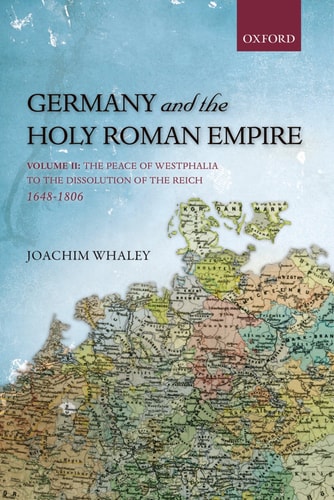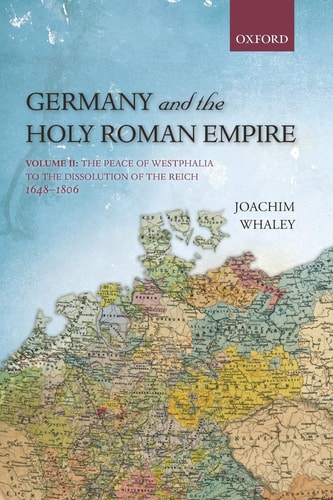
Germany and the Holy Roman Empire: Volume II: The Peace of Westphalia to the Dissolution of the Reich, 1648-1806
0
0
As an Amazon Associate and affiliate partner, Menrva Books earns from qualifying purchases. Learn more
Author Description
Germany and the Holy Roman Empire offers a striking new interpretation of a crucial era in German and European history, from the great reforms of 1495-1500 to the dissolution of the Reich in 1806. Over two volumes, Joachim Whaley rejects the notion that this was a long period of decline, and shows instead how imperial institutions developed in response to the crises of the sixteenth and seventeenth centuries, notably the Reformation and Thirty Years War. The impact of international developments on the Reich is also examined.Volume II begins with the Peace of Westphalia and concludes with the dissolution of the Reich. Whaley analyses the remarkable resurgence of the Reich after the Thirty Years War, which saw the Habsburg emperors achieve a new position of power and influence and which enabled the Reich to withstand the military threats posed by France and the Turks in the later seventeenth century. He gives a rich account of topics such as Pietism and baroque Catholicism, the German enlightenment, and the impact on the Empire and its territories of the French Revolution and Napolean. Whaley emphasizes the continuing viability of the Reich's institutions to the end, and the vitality of a political culture of freedom that has been routinely underestimated by historians of modern Germany.
Menrva's Summary
THE THESIS
This volume investigates the political, institutional, and cultural resilience of the Holy Roman Empire from the Peace of Westphalia in 1648 to its final dissolution in 1806. Joachim Whaley, a scholar of German history, challenges traditional historiography that characterizes this period as one of inevitable decline. By analyzing the development of imperial institutions, the influence of the Enlightenment, and the geopolitical pressures of the era, Whaley argues that the Reich maintained significant vitality and political viability until the Napoleonic collapse.
THE SCOPE MAP
What You Will Find
- Analysis of the post-Westphalia resurgence of Habsburg power and influence.
- Examination of the impact of the French Revolution and Napoleonic wars on German territories.
- Exploration of cultural and religious shifts including Pietism, baroque Catholicism, and the German Enlightenment.
- Assessment of the institutional functionality of the Reich in the face of seventeenth-century military threats.
THE AUTHORITY PERSPECTIVE
Historians and scholars of early modern Europe recognize this work as a definitive, comprehensive study of the Holy Roman Empire's final centuries. Readers frequently note the academic density of the prose, which provides a rigorous and nuanced counter-narrative to older, teleological interpretations of German history.
Page Count:
784
Publication Date:
2013-12-01
Publisher:
Oxford University Press
ISBN-10:
0199688834
ISBN-13:
9780199688838
History
German history
Political History
European History
Germany history