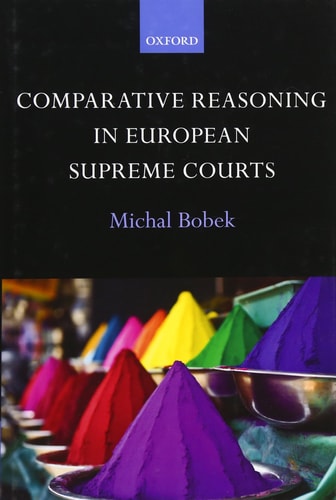
Comparative Reasoning in European Supreme Courts
0
0
As an Amazon Associate and affiliate partner, Menrva Books earns from qualifying purchases. Learn more
Author Description
The last two decades have witnessed an exponential growth in debates on the use of foreign law by courts. Different labels have been attached to the same phenomenon: judges drawing inspiration from outside of their national legal systems for solving purely domestic disputes. By doing so, the judges are said to engage in cross-border judicial dialogues. They are creating a larger, transnational community of judges.This book puts similar claims to test in relation to highest national jurisdictions (supreme and constitutional courts) in Europe today. How often and why do judges choose to draw inspiration from foreign materials in solving domestic cases? The book addresses these questions from both an empirical and a theoretical angle. Empirically, the genuine use of comparative arguments by national highest courts in five European jurisdictions is examined: England and Wales, France, Germany, the Czech Republic, and Slovakia. On the basis of comparative discussion of the practice and its national theoretical underpinning in these and partially also in other European systems, an overreaching theoretical framework for the current judicial use of comparative arguments is developed.Drawing on the author's own past judicial experience in a national supreme court, this book is a critical account of judicial engagement with foreign authority in Europe today. The sober middle ground inductively conceptualized and presented in this book provides solid jurisprudential foundations for the ongoing use of comparative arguments by courts as well as its further scholarly discussion.
Menrva's Summary
THE THESIS
This book investigates the frequency, motivations, and theoretical implications of supreme and constitutional courts in Europe utilizing foreign legal materials to resolve domestic disputes. The author, Michal Bobek, leverages his professional background as a former judge in a national supreme court to bridge the gap between abstract legal theory and actual judicial practice. By synthesizing empirical data from five distinct European jurisdictions with a rigorous jurisprudential analysis, the work establishes a framework for understanding how national courts engage with transnational legal authority. The study moves beyond idealistic notions of judicial dialogue to provide a grounded, critical assessment of how comparative reasoning functions within the constraints of national legal systems.
THE SCOPE MAP
What You Will Find
- Empirical analysis of judicial practices in England and Wales, France, Germany, the Czech Republic, and Slovakia.
- A theoretical framework for the application of comparative arguments in domestic litigation.
- Case studies examining the intersection of national sovereignty and foreign legal inspiration.
- An inductive conceptualization of the 'sober middle ground' regarding judicial engagement with external authority.
THE AUTHORITY PERSPECTIVE
Legal scholars and practitioners frequently cite this work as a foundational text for understanding the practical realities of judicial cross-pollination in Europe. Experts highlight the author's unique perspective as a former judge, which provides a level of pragmatic insight often missing from purely academic treatments of the subject.
Page Count:
340
Publication Date:
2013-11-15
Publisher:
Oxford University Press
ISBN-10:
0199680388
ISBN-13:
9780199680382
Comparative Law
Law europe
European Law
Law
Courts Of Last Resort
Community Tags
Other Editions(3)

Similar Books