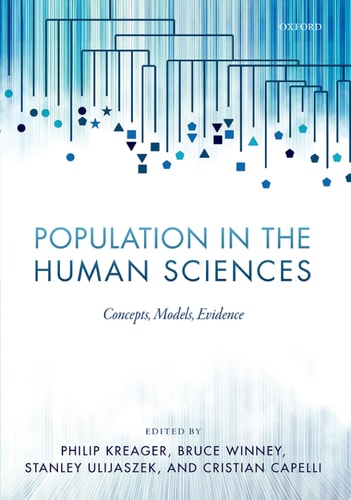
Population in the Human Sciences: Concepts, Models, Evidence
0
0
As an Amazon Associate and affiliate partner, Menrva Books earns from qualifying purchases. Learn more
Author Description
The Human Sciences address problems in nature and society that often require coordinated approaches of several scientific disciplines and scholarly research, embracing the social and biological sciences, and history. When we wish, for example, to understand how some sub-populations and not others come to be vulnerable, why a disease spreads in one part of a population and not another, or which gene variants are transmitted across generations, then a remarkable range of disciplinary perspectives need to be brought together, from the study of institutional structures, cultural boundaries, and social networks down to the micro-biology of cellular pathways, and gene expression. The need to explain and address differential impacts of pressing contemporary issues like AIDS, ageing, social and economic inequalities, and environmental change, are well-known cases in point. Population concepts, models, and evidence lie at the core of approaches to all of these problems, if only because accurate differentiation and identification of groups, their structures, constituents, and relations between sub-populations, are necessary to specify their nature and extent. The study of population thus draws both on statistical methodologies of demography and population genetics and sustained observation of the ways in which populations and sub-populations are formed, maintained, or broken up in nature, in the laboratory, and in society. In an era in which research needs to operate on multiple levels, population thinking thus provides a common ground for communication and critical thought across disciplines.Population in the Human Sciences addresses the need for review and assessment of the framework of interdisciplinary population studies. Limitations to prevailing postwar paradigms like the Evolutionary Synthesis and Demographic Transition were becoming evident by the 1970s. Subsequent decades have witnessed an immense expansion of population modelling and related empirical inquiry.
Menrva's Summary
THE THESIS
This volume investigates the conceptual and methodological challenges inherent in defining and modeling populations across the diverse fields of the human sciences. The authors, a multidisciplinary team of researchers, argue that traditional postwar paradigms—such as the Evolutionary Synthesis and Demographic Transition—require significant reassessment to address contemporary complexities. By synthesizing perspectives from social, biological, and historical disciplines, the text establishes a framework for understanding how population-level data informs our knowledge of social inequality, disease transmission, and biological inheritance.
THE SCOPE MAP
What You Will Find
- Analysis of the limitations within postwar demographic and evolutionary paradigms.
- Examination of the intersection between statistical demography and population genetics.
- Case studies illustrating the application of population models to issues like AIDS, aging, and economic inequality.
- Methodological discussions on identifying and differentiating sub-populations across social and biological contexts.
THE AUTHORITY PERSPECTIVE
Experts recognize this work as a critical contribution to the integration of disparate scientific fields through the shared lens of population thinking. Readers frequently note the academic density of the prose, which serves as a foundational resource for scholars seeking to bridge the gap between social and biological research methodologies.
Page Count:
592
Publication Date:
2015-05-12
Publisher:
Oxford University Press
ISBN-10:
0199688206
ISBN-13:
9780199688203
Science
Anthropology
Demography
Sociology
Genetics
Interdisciplinary Studies
Community Tags
Similar Books


Reader Comments
Share Your Thoughts
No comments yet. Be the first to share your thoughts!