Global Benchmarks
0
0
As an Amazon Associate and affiliate partner, Menrva Books earns from qualifying purchases. Learn more
Author Description
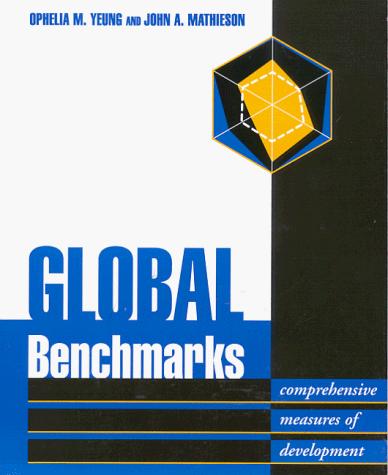
How do you measure the progress countries are making in economic development? Should measurements focus on per capita income or output? Or should assessments also consider education, health, a clean environment, or a participatory political system? Global Benchmarks addresses this need for definitive, comprehensive measures of development by policymakers, economists, and other social scientists. It presents a unique and innovative measurement system for country progress in six aspects of development: economic performance, competitiveness, education, health, environment, and democracy and freedom. The authors scored over 100 countries individually and plotted their development performance along six vectors, allowing them to be benchmarked against one another. Their unique charts illustrate at a glance whether the country's development is balanced and allow both regional and international comparisons. This book presents the conceptual framework supporting a development web model, the scoring systems, and 100 individual country development webs accompanied by discussions of their scores and conditions in those countries.
Menrva's Summary
THE THESIS
This book confronts the challenge of quantifying national progress by proposing a novel, multi-dimensional measurement system for country development. It addresses the debate between traditional economic indicators like per capita income and broader measures encompassing education, health, environment, and political systems. The authors introduce a 'development web' model to visually represent and compare the progress of over 100 countries across six key aspects: economic performance, competitiveness, education, health, environment, and democracy and freedom.
THE SCOPE MAP
- A conceptual framework for a development web model.
- Detailed scoring systems for assessing country progress.
- 100 individual country development webs with score discussions.
- Analysis of balanced development and regional/international comparisons.
THE AUTHORITY PERSPECTIVE
The book presents a comprehensive framework for measuring national development, offering a unique visual tool for policymakers and economists. Its innovative approach allows for at-a-glance comparisons of country progress across multiple dimensions. The inclusion of individual country webs provides specific insights into their development trajectories. This work aims to provide definitive measures for understanding and benchmarking global development.
Page Count:
346
Publication Date:
1998-01-01
ISBN-10:
0815796811
Politics
Non-Fiction
Economics
Social Science
Comparative Politics
Community Tags
Similar Books